Did the USPTO Fix IDS Abuse?
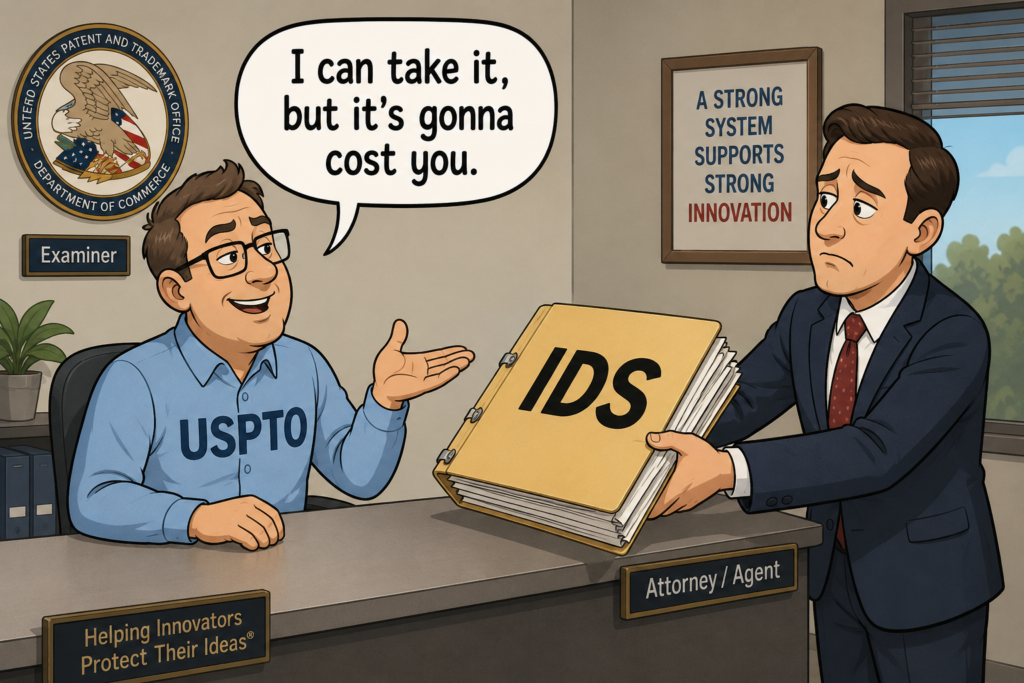
For years, some patent practitioners have treated the Information Disclosure Statement (IDS) like a game of “more is better.” If ten references are good, fifty must be better. If fifty are good, why not submit two hundred?
According to recent data highlighted by Patently-O, that practice may finally be changing.
In January 2025, the USPTO implemented new IDS size surcharges. Applicants now pay additional fees once the cumulative number of cited references exceeds certain thresholds. The result was immediate. The average number of applicant-submitted references dropped by roughly 27%, while the highest-volume filers reduced their submissions by even more.
Economists would say this is exactly what should happen when you raise the price of something. But the more interesting question is whether this change is actually good for patent examination.
The Problem with Massive IDS Filings
Patent applicants have a duty to disclose information material to patentability. Nobody disputes that.
What has always been controversial is the practice of submitting dozens, or even hundreds, of references with little attempt to distinguish which ones actually matter.
From our perspective, that approach often serves two purposes.
First, it can hide the truly relevant references inside a mountain of less relevant material. If an examiner receives a stack of hundreds of citations, the references that deserve close attention can become harder to identify.
Second, large IDS submissions can become a substitute for doing the hard work. Instead of carefully analyzing the invention and identifying the most relevant prior art, the practitioner simply submits everything remotely related to the technology.
Neither approach helps the examiner. Neither approach improves patent quality.
More References Does Not Mean Better Examination
The patent system works best when applicants and examiners focus on the prior art that actually matters.
An IDS containing ten highly relevant references is often far more useful than an IDS containing two hundred references of varying significance. Examiners have limited time. Burying key references inside a massive disclosure package does not make examination more thorough. It often makes it more difficult.
That is one reason we have long questioned the value of oversized IDS filings.
The New Fees Are Changing Behavior
The USPTO’s new surcharge structure applies when the cumulative number of references exceeds 50, 100, and 200 references during prosecution.
Importantly, the data suggests that most applicants are unaffected. The median patent application already contains relatively few cited references. The fee primarily targets the small percentage of applications that generate extraordinarily large IDS submissions.
Those are also the applications responsible for a disproportionate share of all references submitted to the USPTO.
The result appears to be exactly what the USPTO intended: fewer massive IDS filings.
Will Patent Quality Improve?
That remains to be seen.
Critics argue that any financial disincentive could discourage disclosure of relevant prior art. That concern should not be dismissed. Applicants still owe a duty of candor to the Patent Office, and material prior art must still be disclosed.
On the other hand, if the new fees encourage practitioners to spend more time identifying the most relevant references rather than submitting every reference they can find, the quality of examination could actually improve.
For years, many practitioners have complained that oversized IDS filings create more noise than signal. The early data suggest that the USPTO’s new fees may finally be reducing that noise.
Whether that leads to better patents is a question worth watching.
Previous articles related to this: The USPTO’s New Fee Structure for Large Information Disclosure Statement Filings