The DABUS Case and the Question of AI Inventorship
On June 6, 2022 the Federal Circuit heard the oral arguments in the future landmark case Thaler v Vidal. These discuss the recent question on whether an AI could be the “inventor” listed on a patent application. In 2019, Thaler filed two patent applications, listing an AI called DABUS as the inventor of the two patents. The USPTO’s refused to grant Thaler the patents. Furthermore, the United States District Court for the Eastern District of Virginia upheld the USPTO’s decision.
How the Patent Act Defines an “Inventor”
The Patent Act defines “inventor” as the individual(s) who “invented or discovered the subject matter of the invention.” Therefore, the oral argument on June 6 focused mainly on the meaning of the term “individual.” The Federal Circuit seemed skeptical of the idea that a machine can “invent” patentable subject matter with no human input. Similarly, in arguing for the USPTO, Barghaan insisted that inventions created entirely without human involvement are not patentable. Barghaan pointed out that in the Patent Act, Congress specifically defines the term “individual”. It does so using gender personal pronouns, which clearly indicates individuals as human beings, rather than machines. Moreover, Barghaan contended that allowing AI “inventions” to be patented would “open Pandora’s box” and create numerous problems. For example, he asked, how would you depose an inventor such as DABUS?
Arguments Supporting Patent Protection for AI-Generated Inventions
Countering that, Thaler’s counsel, Abbott, noted that the Patent Act has routinely been interpreted to give terms broad meaning in order to promote innovation.
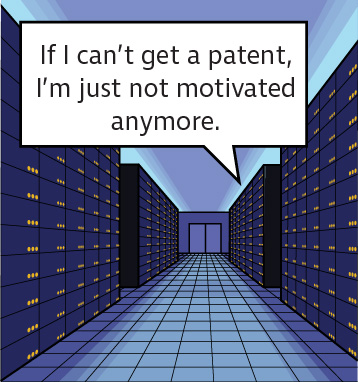
Interestingly, he contended that refusing to grant patents for subject matter invented by an AI would have a negative implication. Namely, telling companies not to use machines in research and development.
According to Abbott’s observation, if an invention created entirely by an AI cannot be patented, companies would be disincentivized from investing in and using AI for fear of being denied protection of new inventions. This could prevent beneficial breakthroughs, such as those in the medical field. Thus, Abbott stated, interpreting “individuals” to include only natural persons will prevent innovation. That’s the opposite of what Congress intended to promote through the Patent Act.
Prior Supreme Court Guidance on the Meaning of “Individual”
It will be interesting to see what the Federal Circuit decides. However, it seems unlikely that the court will find in favor of Thaler. In particular, the court remarked that in Mohamad v. Palestinian Auth, the Supreme Court held that an inventor is a natural person. Abbott argued that such interpretation specifically applied only to the particular circumstances of that case. Furthermore, the Patent Act has been routinely interpreted broadly to promote innovation. However, Abbott also conceded that since Mohamad (and the Patent Act), there has been no new decision re-interpreting “individual.”
Why the Federal Circuit’s Decision Could Shape the Future of Patent Law
No matter the outcome, the Federal Circuit’s decision will have great significance. It will considerably shape the way we think of patentable inventions. For an interesting insight on how AI might influence patent law, see How AI Might Reboot Patent Law. The article was published on Artificial Intelligence (AI) & the Law For Social Impact and Equity. It is part of a series of four blog posts analyzing Thaler’s allegations. In the first post of the series, the authors describe how Thaler has brought this fight in numerous other countries. And so far, he hasn’t had much luck in overcoming objections.

Lucia Minnucci, LL.M
Lucia Minnucci is a Law Clerk at Fish IP™. Lucia received her first degree in law from the University of Bologna, in Bologna, Italy. After obtaining her law degree, Lucia received an LL.M degree from the University of Pennsylvania Carey Law School, with a concentration in Intellectual Property and Technology Law.