On Friday the 13th, the Federal Circuit turned what began as a procedural APA challenge into something much larger: a precedential confirmation that the USPTO Director possesses extraordinarily broad discretion over whether to institute inter partes review (IPR).
In Apple Inc. v. Squires, the court did far more than uphold the now-obsolete NHK/Fintiv framework. It effectively declared that the Director’s institution authority is constrained only by the Constitution — or by whatever limits the Director chooses to impose on himself.
The Origin: NHK and Fintiv
The controversy began when former Director Iancu designated as precedential two PTAB decisions:
Together, those cases established six non-exclusive factors — the “Fintiv factors” — guiding discretionary denial of IPR when there is parallel district court litigation. The factors emphasized judicial efficiency, trial timing, overlap of issues, and related considerations.
Apple and several other technology companies challenged the adoption of these factors, arguing that the USPTO violated the Administrative Procedure Act (APA) by failing to use notice-and-comment rulemaking.
The Statutory Wall: “Final and Nonappealable”
The challenge ran into 35 U.S.C. § 314(d), which provides that institution decisions are “final and nonappealable.”
The Supreme Court has interpreted that language broadly in:
- Cuozzo Speed Technologies, LLC v. Lee
- SAS Institute Inc. v. Iancu
Those decisions make clear that the Director’s choice whether to institute IPR is largely insulated from judicial review.
Initially, the district court dismissed Apple’s case as unreviewable. The Federal Circuit briefly revived it — but only on a narrow procedural question: whether adoption of the Fintiv factors required notice-and-comment rulemaking. Substantive review of institution discretion remained off the table.
The Critical Reframing: “Instructions,” Not Rules
On remand, the district court held that the Fintiv factors were exempt from notice-and-comment rulemaking because they were not “substantive rules.”
When the case returned to the Federal Circuit in Apple v. Squires, the panel took an even more consequential step. It reframed the Fintiv factors not as rules governing a quasi-judicial body, but as “instructions” from the Director to his subordinates at the PTAB.
That shift changed everything.
Because the Director is the statutory decisionmaker, and because the Fintiv instructions did not bind the Director himself, the court held they were merely “general statements of policy” — expressly exempt from APA notice-and-comment requirements.
The logic was straightforward but sweeping: Only rules that bind the Director’s own discretion could qualify as substantive. Guidance the Director gives to others about how to exercise his discretion does not.
No Right to Institution Means No APA Hook
The Federal Circuit reinforced its conclusion with an even broader principle: there is no legal right to IPR institution.
Congress created IPR as a discretionary regime. A denial of institution:
- Does not invalidate or alter patent rights.
- Does not prevent validity challenges in district court.
- Does not foreclose reexamination.
In short, a non-institution decision leaves a challenger in exactly the same legal position it would have occupied had Congress never created IPR at all.
Because no legal rights are altered, rules discouraging institution cannot be “substantive” in a way that triggers APA procedural protections. This reasoning significantly narrows the scope of possible APA challenges going forward.
The Irony: Apple Won the Battle, Lost the War
Apple’s goal was to cabin discretionary denials and require formal rulemaking. Instead, the litigation produced binding precedent establishing the opposite principle.
The Federal Circuit made clear:
- Institution decisions are substantively unreviewable.
- Internal guidance on how to deny institution does not require notice-and-comment rulemaking.
- Only rules binding the Director himself could potentially be substantive.
- Non-institution does not affect legal rights in a way that triggers APA protections.
Even More Discretion Today
Compounding the impact, institutional changes during the appeal centralized authority even further. Acting Director Stewart rescinded prior Fintiv guidance and restructured review procedures. Director Squires later indicated he would personally decide institution questions based on both discretionary and merits factors.
The result is a regime even more concentrated than the one Apple originally challenged — with discretionary denial no longer meaningfully cabined by the Fintiv framework.
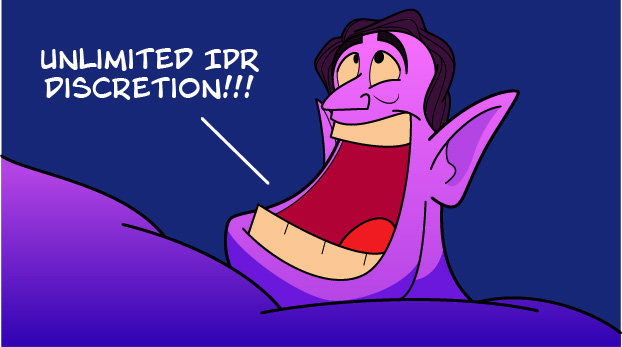
The Bottom Line: Nearly Unbounded Authority
The practical effect of Apple v. Squires is profound.
The USPTO Director now possesses institution authority that is, for all practical purposes, nearly unbounded:
- No notice-and-comment rulemaking required for discretionary guidance.
- No substantive judicial review of denial decisions.
- No recognized legal entitlement to institution.
- Only possible limits: constitutional constraints or self-imposed restrictions.
In trying to rein in discretionary denial, Apple secured a precedential ruling that cements it. The Director’s authority over IPR institution is now clearer than ever — and broader than when the case began.