Recent USPTO data shows a sharp gap in patent allowance rates by entity size. Large entities saw about an 80% allowance rate, small entities around 61%, and micro-entities just 40%. At first glance, it’s tempting to suspect that USPTO fee discounts come with consideration discounts too.
That’s almost certainly the wrong conclusion.
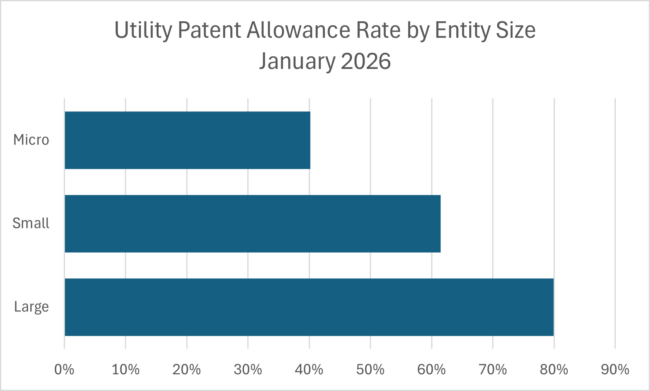
Why USPTO Fee Discounts Do Not Affect Patent Examination
USPTO examiners are not incentivized based on applicant size or fee status. Entity classification affects what applicants pay—not how claims are examined. There’s no procedural hook for “micro-entity skepticism” baked into the system.
If discounted fees were driving worse outcomes, we’d expect to see some evidence of that in examiner behavior. We don’t.
The Real Reason Micro-Entity Patent Allowance Rates Are Lower
A more plausible explanation is structural, not institutional.
Micro-entities are disproportionately individual inventors. Unlike large companies, they typically lack internal screening processes that filter out weaker inventions before filing. Corporations reject many invention disclosures internally and file only after patentability and business value have both been vetted.
Individual inventors, by contrast, are closer to their inventions and often filing without:
- Broad prior-art visibility
- Repeated exposure to what doesn’t patent well
- Institutional memory of past prosecution failures
That difference alone can account for a lot of the disparity.
Why Patent Prosecution Resources and Stamina Matter
Patentability isn’t binary. Many patentable inventions still require:
- Multiple office-action responses
- Claim narrowing
- RCEs or appeals
Large entities budget for that reality. Micro-entities often don’t. When costs rise faster than perceived value, abandonment becomes rational—even for inventions that could have issued.
Lower allowance rates may therefore reflect earlier exits, not weaker inventions.
How Individual Inventors Can Improve Their Patent Allowance Odds
None of this is destiny. Inventors can materially improve their odds by borrowing a few habits from larger players:
- Be selective. Not every good idea needs a patent. File where narrower claims would still matter.
- Invest early in patentability analysis. Modest upfront diligence can prevent expensive dead ends.
- Treat the provisional as real work. Weak disclosures constrain everything that follows.
- Budget for prosecution, not just filing. Persistence is often the difference between issuance and abandonment.
- Define success realistically. A narrower, enforceable patent is often better than chasing broad claims that never issue.
What USPTO Patent Allowance Data Actually Shows
The data does not suggest that the USPTO fee discounts disfavor applicants. It suggests that scale brings discipline, resources, and endurance, all of which improve patent outcomes.
For inventors, the lesson isn’t that the system is biased—it’s that smart selection, solid drafting, and realistic prosecution planning matter just as much as the invention itself.
Check out another of our articles on entity sizes: When Trying to Save Money May Cost More