Enablement Depends on Context
In patent law, “enablement” is critical. However, the required detail varies depending on your goal—getting a patent or invalidating one.
This distinction became clear in Agilent Technologies v. Synthego. The principle is simple but powerful: To secure a patent claim, you must enable enough embodiments to cover its full scope. Yet, to invalidate a claim, you only need prior art enabling one embodiment. This rule isn’t new, but the case clarifies it sharply.
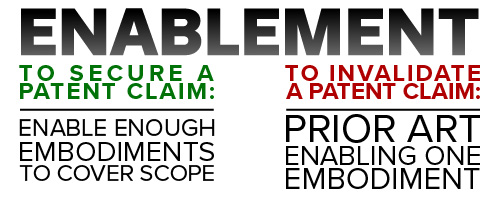
The Two Faces of Enablement
Under Section 112, inventors must enable the full scope of their claimed invention. This prevents overbroad patents that exceed the disclosure.
You cannot describe one version of an invention and claim all variations. Instead, you must teach the public how to make and use everything claimed.
The Supreme Court reinforced this in Amgen v. Sanofi. There, a broad antibody patent was invalidated because it disclosed only a few examples. The rest required undue trial and error, which the Court rejected.
By contrast, Agilent v. Synthego draws a sharp line. Anticipatory prior art—references that can invalidate a patent—does not need to enable every version. It only needs to enable one working embodiment.
A Research Proposal as Prior Art
Agilent’s patents covered chemically modified guide RNAs (gRNAs) that resist degradation in CRISPR gene editing.
Synthego challenged them using an abandoned Pioneer Hi-Bred application. This reference described broad theoretical possibilities for modifying gRNAs, but:It contained no proven examples.
- It proposed quadrillions of combinations.
- It was ultimately withdrawn after failing to work.
Agilent argued the reference was not enabling, likening it to Amgen’s vague disclosures. However, the court disagreed. The difference is simple: Amgen concerns patent applications, while Agilent addressed prior art. The disclosure bar is lower for invalidation.
Why This Matters
The court’s approach creates a clear firewall between two standards:
- Section 112 enablement: You must enable your full claimed scope for a valid patent.
- Prior art enablement: A reference must only enable a single working embodiment to defeat novelty.
This distinction significantly affects patent strategy and litigation.
The Power of Prophetic Prior Art
The Pioneer Hi-Bred application never worked and was abandoned. Most examples were prophetic and unproven. Yet the court ruled that if even one example is enabling, a patent can be invalidated. This shows prophetic prior art can be surprisingly powerful.
Key Takeaway
If you seek a patent, you face the high Amgen enablement standard. You must teach others to make and use your invention fully.
However, to invalidate another’s patent, even speculative, abandoned prior art can suffice—so long as it enables one embodiment.
Agilent v. Synthego teaches us this: In patent law, not all enablement is equal.
For some related articles on the effect of prior art during litigation, consider these: What Did Those Claims Consist Of?
Generic Drug Label Doesn’t Induce Patent Infringement Just by Listing Optional Refrigeration