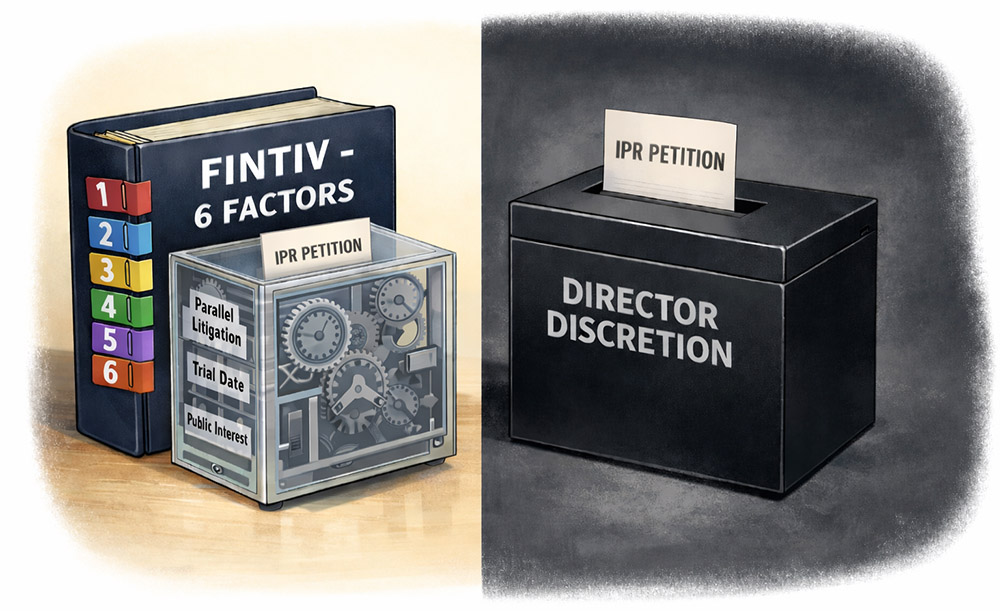
The rule book and the black box
The Use of the Inter Partes Review in Infringement Accusations
You’re facing an infringement suit. A common defensive tactic is to challenge the validity of the patent claims asserted against you through an Inter Partes Review (IPR). In an IPR, the petitioner asks the PTAB to cancel one or more patent claims that are asserted in court.
Discretionary Denial of an IPR
Given that this is such a common tactic, the PTAB can’t just institute an IPR upon request. This would tie up too many resources on frivolous, time-wasting challenges. So the rule, 35 U.S.C. § 314(a), says:
“The Director may not authorize an IPR… unless…there is a reasonable likelihood that the petitioner would prevail with respect to at least one of the claims challenged in the petition.”
The Director first assesses whether the petition meets the merits threshold. Even if that threshold is met, the Director may still exercise discretion to deny institution based on policy factors.
2020 Apple v. Fintiv Produces the “Fintiv factors” for IPR Denial
Fintiv sued Apple for infringement in late 2018, and the case was still pending into 2019.
Apple filed for an IPR, as one does, to challenge the validity of Fintiv’s patents, at the end of Oct 2019.
Then the District Court set the trial date for Nov 2020.
The November 2020 trial date caused Fintiv to argue that the PTAB should deny institution. The PTAB articulated six “Fintiv factors” to guide discretionary denials in situations with parallel litigation. These factors apply only when overlapping court proceedings exist—not to every IPR—but because parallel litigation is so common, the framework affects many contested petitions. Fintiv structured discretionary denials based on efficiency and overlap, though a petition could still be instituted if the factors favored it.
2022 Vidal Memorandum Reduces Fintiv Factor Denials
Director Vidal issued a memorandum limiting the aggressive use of Fintiv factors. The guidance emphasized that compelling evidence of unpatentability or procedural safeguards like a Sotera stipulation should generally prevent denial based solely on parallel litigation.
2025 The Return of the Fintiv Framework
Acting Director Coke Stewart rescinded the Vidal Memorandum. She explained that the 2022 guidance was interim and tied to possible rulemaking, which never occurred. With its withdrawal, the PTAB returns to the broader discretionary denial practice under Fintiv, allowing the Board to fully consider the factors without the limitations imposed by Vidal’s memo.
Implications for Patent Stakeholders
For patent owners, the return of the Fintiv framework means timing is more important than ever. Accelerating district court proceedings or managing trial schedules strategically can influence whether a parallel IPR is instituted. For accused infringers, filing early IPR petitions and considering procedural tools—like Sotera stipulations or early motions to stay in court—can be critical to reduce risk of discretionary denial. Overall, both sides must now coordinate litigation and PTAB strategy carefully, because the Board once again has broad discretion to deny institution when overlapping litigation exists. Staying agile and planning for both forums simultaneously can make the difference in protecting or enforcing patent rights.
For more updates on IPR discretion: Protecting the Little Guy… or Bad Patents?