PTAB § 101 Affirmance Rates Continue to Climb
For inventors and patent practitioners, securing a patent has always been challenging. Overcoming a § 101 rejection is even harder. The latest 2023 data confirms a troubling trend. The Patent Trial and Appeal Board upheld examiner § 101 rejections 91% of the time. That number rose from 87.1% in 2021 and 88.4% in 2022. The trend makes one thing clear. Appealing a § 101 rejection usually ends in disappointment.
Why the PTAB Is So Tough on § 101 Appeals
The high affirmance rate is not just about weak applications. It reflects deeper structural problems.
Since the Supreme Court’s Alice Corp. v. CLS Bank decision, patent eligibility law has been unstable. The framework remains confusing and inconsistent.
The Federal Circuit has issued conflicting rulings. Meanwhile, the PTAB often disregards the USPTO’s own eligibility guidance. This inconsistency has produced strange outcomes. In some cases, a diamond-encrusted drill bit and a camera phone were labeled “abstract ideas.” As a result, applicants face unpredictable decisions. Outcomes often feel arbitrary rather than grounded in clear legal standards.
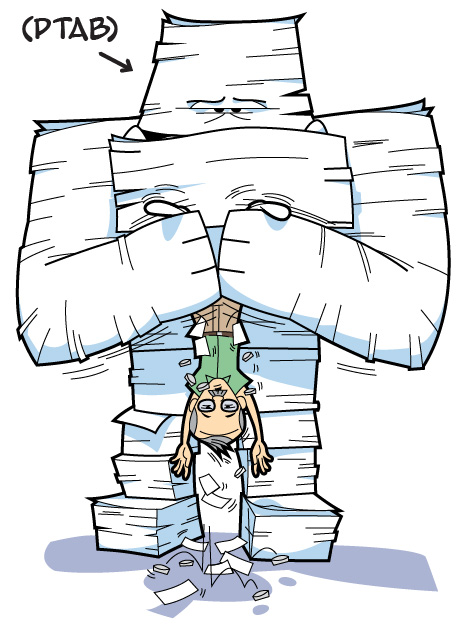
The Patent Beast as the PTAB
Which USPTO Technical Centers Are the Harshest?
Not all USPTO Technical Centers treat § 101 appeals equally. Some are significantly tougher than others.
TC3600 and TC3700: Business Methods and Financial Technology
These centers have the worst outcomes. Affirmance rates exceed 95%. Business method patents frequently land in these centers. Inventors in these fields face especially steep odds.
TC2100: Computing and Software Technologies
TC2100’s affirmance rate climbed to 85% in 2023. It stood at 80% in 2022. This increase suggests broader trouble for software patents. The impact extends beyond business methods.
Other Technical Centers
Some technical centers show lower affirmance rates. However, the data is limited. TC2400 and TC2600 may offer slightly better outcomes for software-related applications. Still, results vary.
The Most Common “Abstract Idea” Categories
The PTAB typically relies on three main categories when affirming § 101 rejections.
- Mathematics (17% of affirmances)
- Mental processes (48%)
- Methods of organizing human activity (68%)
These categories often overlap. Some applications are rejected under multiple rationales.
Mental process rejections are common in TC2100. Organizing human activity dominates TC3600 decisions.
The Hidden Risk: New § 101 Rejections on Appeal
Even if an examiner does not issue a § 101 rejection, risk remains. The PTAB can introduce one. In 10% of cases, the PTAB issued a new § 101 rejection. These applicants were caught off guard. This risk is especially high in TC2100. Examiners there may be more lenient during prosecution. The PTAB often is not.
Strategic Options for Responding to a § 101 Rejection
Given these statistics, appealing is rarely the best first move. Strategic prosecution decisions matter more than ever.
Applicants should consider several approaches.
- Work with the examiner to amend claims and pursue allowance before appealing.
- Use TC steering tools to anticipate assignment outcomes.
- Avoid TC3600 and TC3700 when possible.
- Carefully evaluate claim amendments before filing any appeal.
When an appeal is unavoidable, preparation is critical. Expect a difficult path.
Final Thoughts on § 101 Appeals at the PTAB
The PTAB’s 91% affirmance rate in 2023 is a serious warning. The system remains inconsistent and difficult to navigate.
Legislative or judicial reform may eventually bring clarity. Until then, early prosecution strategy is essential.
Once an application reaches the PTAB, the odds of reversal are slim.
Check out our FishFAQ video: Rejections