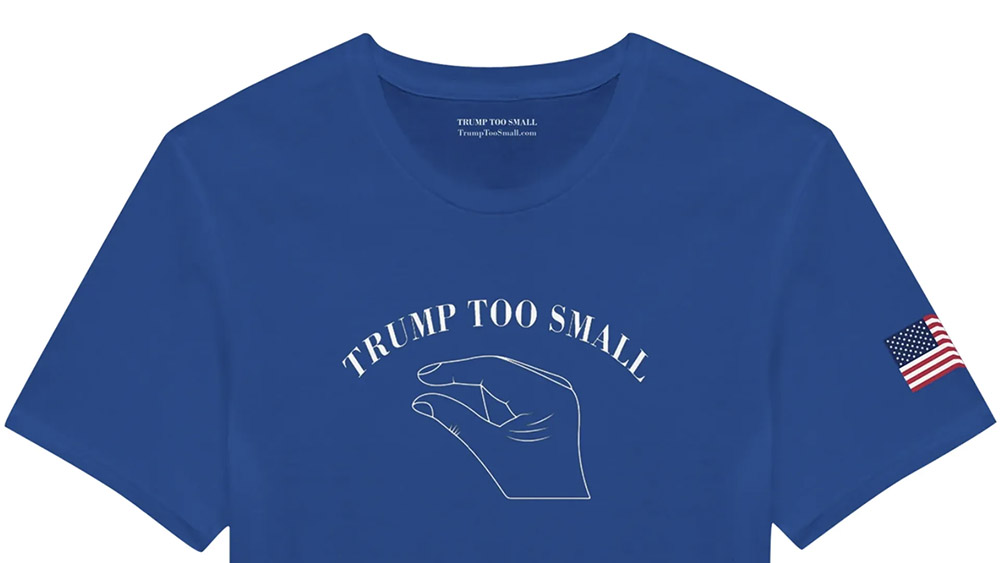
The Supreme Court recently decided, in Vidal v Elster, that the TTAB’s refusal to register the TRUMP TOO SMALL mark, was not a violation of First Amendment rights.
Background of the TRUMP TOO SMALL Trademark Application
USPTO Refusal Under the Lanham Act Names Clause
Back in 2018, Steve Elster sought to register a mark of “TRUMP TOO SMALL” as a t-shirt slogan. This was inspired by an exchange between Trump and Marco Rubio during the 2016 Republican primary. The PTO examiner refused on the grounds that the mark violated the ‘names clause’ of the Lanham Act. That act requires written consent for a mark containing the name of a living individual.
Elster countered that the ‘names clause’ was a violation of his first amendment free-speech rights. The examiner, however, responded that refusing registration doesn’t constitute a restriction on free speech. For reference, the PTO has also refused trademark registrations on “WELCOME PRESIDENT BIDEN”, “I STUMP FOR TRUMP”, and “OBAMA PAJAMA”.
TTAB Affirms Refusal of Registration
So Elster appealed the decision before the Trademark Trials and Appeals Board. But the TTAB affirmed the original decision barring Elster from registering the mark.
Federal Circuit Reversal in Re: Elster (2022)
Elster appealed the TTAB decision before the Federal Circuit. The Court noted that section 2 of the Lanham Act requires the PTO to refuse registration of certain categories of proposed trademarks. But in the last five years, the Supreme Court held two provisions in section 2 unconstitutional.
While the Federal Circuit acknowledged the TTAB’s point that the registration bar doesn’t “prevent Elster from communicating his message, it can legally disadvantage the speech at issue here.”
Political Speech and First Amendment Protections
The Fed Circuit stated that it is one of the prerogatives of American citizenship to criticize public men. In fact, the first amendment has its fullest and most urgent application to speech concerning public officials.
Therefore, suppressing the right to praise or criticize governmental agents can’t be squared with the first amendment.
Public Figures and Trademark Publicity Interests
The TTAB acknowledged this right. But added that the government’s interest in protecting privacy and publicity rights was seen to outweigh it. The Federal court argued here that Trump, as a public political figure can’t expect privacy. It further noted that one of the fundamental reasons for trademarks in the first place is the need to safeguard against the dilution of commercial value of his name, and that was not applicable here either. In summary, the government had no valid publicity interest that could overcome the first amendment protections afforded to the political criticism in Elster’s mark. As such, the Federal Circuit reversed the TTAB’s decision.
Supreme Court Review in Vidal v. Elster (2023–2024)
In 2023, the Supreme court agreed to review the judgment. The point being to resolve whether the Lanham Act’s names clause violates the First Amendment.
Content-Based vs. Viewpoint-Based Trademark Restrictions
The Supreme Court considered the issue as distinguishing between content-based, and content-neutral regulations of speech.
Content-based regulations target speech based on its communicative content and is presumptively unconstitutional. Viewpoint discrimination targets not merely subject matter, but particular views taken by speakers on the subject. Trademark restrictions that discriminate based on viewpoint violate the first amendment.
Because the names clause doesn’t single out a trademark based on the specific motivating ideology or the opinion of the speaker, it doesn’t facially discriminate against any viewpoint. But it may still be found to discriminate on viewpoint in its practical operation. Elster suggested this was the case here. It would be easier to obtain a mark if it flattered rather than mocked a subject. But there are many reasons why a person might want to withhold consent to register a trademark bearing his name.
Historical Limits on Trademarking Personal Names
While the names clause is not viewpoint based, it is content based because it applies to particular speech because of the topic discussed or the message expressed, so it turns on whether the proposed trademark contains a person’s name.
The Supreme Court reasoned that although a content-based regulation of speech is presumptively unconstitutional, it had not decided whether heightened scrutiny extends to a content-based, but viewpoint-neutral, trademark restriction. Trademark rights have always coexisted with the first amendment, and the inherently content-based nature of trademark law has never been a cause for constitutional concern.
Restrictions on trademarking names have historically been grounded in the notion that a person has ownership over his own name, and that he may not be excluded from using that name by another’s trademark. So the court issued a narrow decision that, in this instance, the particular restriction does not violate the first amendment.
You might be interested in this article on Trademarks too: A Tale of Trademark Law, the Rogers Test, and Parody