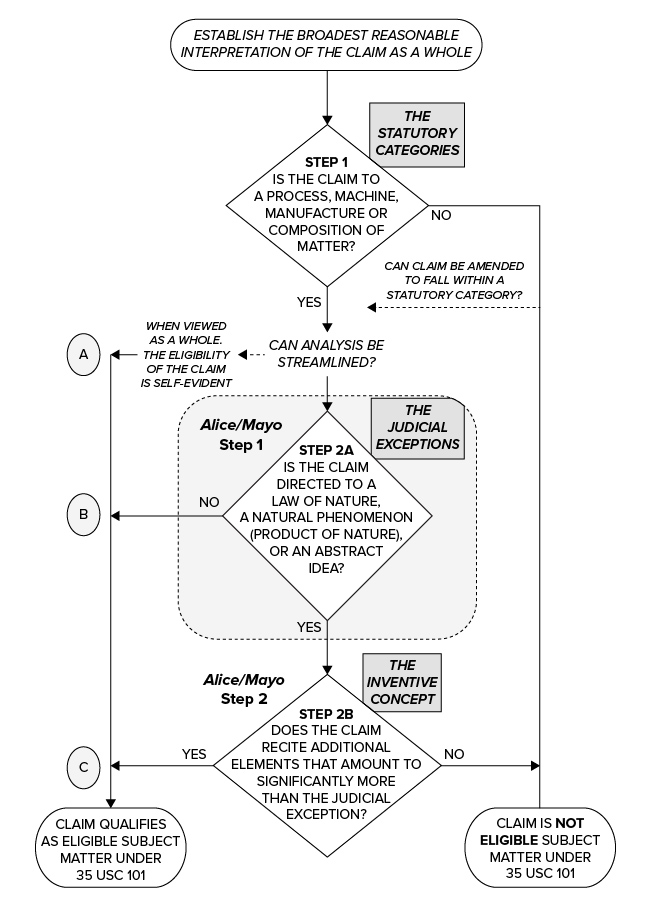
The US Patent Office continues to issue guidance on subject matter eligibility under 35 U.S.C. § 101. This latest July guidance addresses AI-assisted inventions, and adds very little to what we already know. Basically, AI cannot be named as an inventor, and otherwise AI-assisted inventions are prosecuted the same as non-AI assisted inventions.
Invention Subject Matter Eligibility
All kinds of things are eligible for patentability under the USPTO guidelines: process, machine, manufacture, or composition of matter. There are some judicial exceptions that the courts have determined are the basic tools of scientific and technological work. As such, are excluded from patentability since monopolization of these tools would tend to impede innovation more than promote it. Those judicial exceptions are laws of nature, natural phenomena, and abstract ideas.
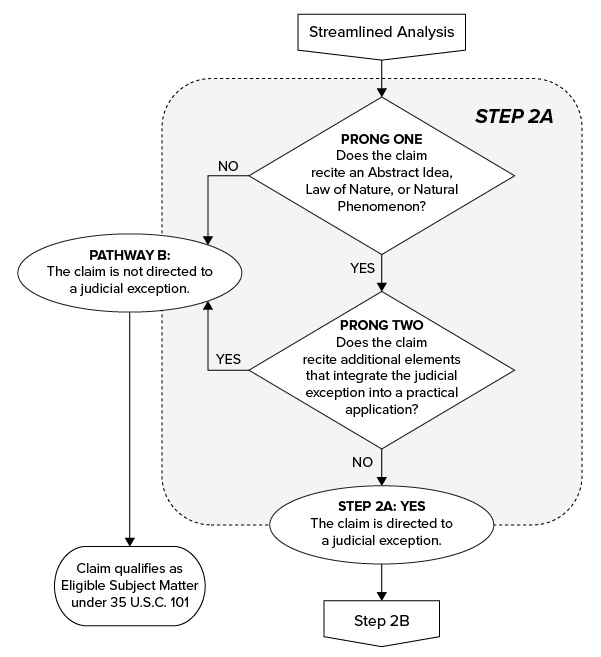
But the courts have decided that if a patent claim can recite “additional elements” that integrate the judicial exception into a practical application, then such a claim can be eligible for patentability.
First Prong: Claims Directed Towards Judicial Exceptions
In the first prong, there is an evaluation of whether a claim recites an abstract idea.
It is common for claims to AI inventions to involve abstract ideas. However, PTO personnel must draw a distinction between a claim that recites an abstract idea, and one that is merely based on an abstract idea.
The USPTO has defined three groupings of abstract ideas: mathematical concepts, methods of organizing human activity, and mental processes.
Mathematical concepts
The mathematical concepts abstract idea grouping is defined as mathematical relationships, mathematical formulas or equations, and mathematical calculations. Claim limitations do not fall within this grouping merely because they are based on or involve a mathematical concept.
Methods of Organizing Human Activity
This abstract idea grouping covers fundamental economic principles, including hedging, insurance, and risk mitigation.
It also includes commercial or legal interactions, such as contracts, legal obligations, advertising, marketing, sales activities, and business relationships.
Additionally, it encompasses managing personal behavior, relationships, or interactions between people, including social activities, teaching, and following rules.
Mental Processes
Courts consider a mental process abstract if it can be performed in the human mind or with pen and paper.
Second Prong: Additional Elements
If the claim under evaluation is directed towards one of these judicial exception areas, then the second prong of the evaluation is to identify whether there are any additional elements that would integrate the exception into a practical application. Many claims to AI inventions are eligible as improvements to the functioning of a computer or improvements to another technology or technical field. While the courts haven’t provided an explicit text for how to evaluate the improvements consideration, they have instead illustrated how it is evaluated in numerous decisions.
A key point of distinction for AI inventions is between a claim that reflects an improvement to a computer or other technology (eligible) and a claim in which the additional elements amount to no more than a recitation of the words “apply it” or are no more than instructions to implement a judicial exception to a particular technological field (ineligible).
Eligibility and AI-assisted Inventions
AI assistance is not a consideration in subject matter eligibility analysis. Patent protection can be sought for AI assisted inventions where one or more persons made a significant contribution to the claimed invention. The current guidance does not provide for recognition of tools like AI for inventorship purposes.