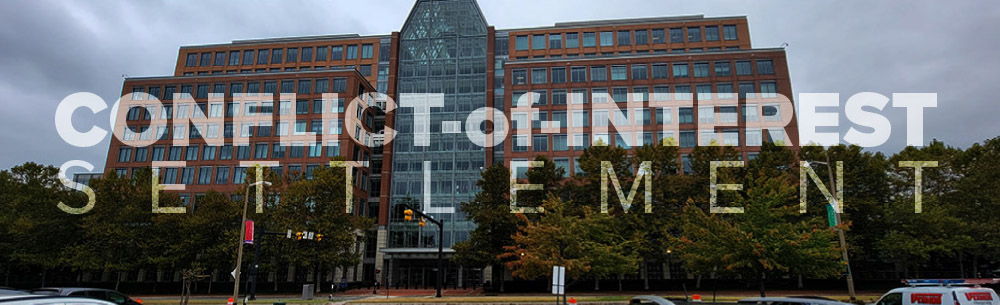
USPTO Examiner Agrees to $500,000 Conflict-of-Interest Settlement
A major USPTO examiner conflict settlement is drawing attention to ethics oversight inside the U.S. Patent and Trademark Office. Patent examiner Daxin Wu has agreed to pay $500,000 to resolve allegations that she reviewed patent applications from companies in which she held substantial stock—far exceeding federal ethics limits.
The U.S. Department of Justice announced the civil settlement on February 25, 2026. Between 2019 and 2022 Wu examined at least nine applications involving companies where she owned hundreds of thousands of dollars in stock, including over $900,000 in one company’s competitor.
Federal regulations (5 C.F.R. § 2640.202) allow examiners to hold no more than $15,000 in a single company under review or $25,000 across an industry sector—amounts dwarfed by Wu’s alleged holdings.
Federal Conflict-of-Interest Law and Ethics Reform Act Explained
The allegations underlying this USPTO examiner conflict settlement center on 18 U.S.C. § 208, a criminal conflict-of-interest statute barring executive branch employees from participating personally and substantially in matters affecting their financial interests. Willful violations can carry up to five years’ imprisonment.
However, the matter was resolved civilly under the Ethics Reform Act of 1989, without any admission of liability. There is no public indication of disciplinary action beyond the financial penalty, and the DOJ press release describes Wu in the present tense as a USPTO examiner.
Inspector General Report Found Systemic USPTO Ethics Failures
The case follows a 2024 report by the U.S. Department of Commerce Office of Inspector General. That report concluded the USPTO and the Department of Commerce failed to effectively administer their ethics program for patent examiners.
In a sample of 73 examiners, 26 had potential financial conflicts that ethics officials failed to identify. Projecting that rate across approximately 7,000 examiners required to file confidential financial disclosure reports, the OIG estimated that roughly 30% may have had undiscovered conflicts in 2022.
The Wu matter appears to be the first public enforcement action to emerge from those referrals, making this USPTO examiner conflict settlement particularly significant in light of the OIG’s findings.
Confidential Financial Disclosures and Oversight Gaps
Patent examiners at GS-13 through GS-15 must file annual confidential financial disclosure reports (CFDRs), listing assets and stock holdings over $1,000.
These reports are reviewed internally by ethics officials but are not publicly available, limiting external scrutiny.
The OIG also identified inconsistent ethics guidance. Some examiners reportedly believed they could hold up to $50,000 in industry stock without triggering recusal obligations. This is about double the actual regulatory cap. While that misunderstanding does not approach the magnitude of Wu’s alleged holdings, it suggests broader compliance and training issues that give context to the USPTO examiner conflict settlement.
The complexity of applying “industry sector” rules makes accurate conflict monitoring challenging. This is especially true in technology art units covering large swaths of the software market. The oversight system is intended to catch what self-reporting may miss.
What Happens to the Patents She Examined?
The settlement resolves the government’s civil claims against the examiner. It does not address the legal status of the patents she examined.
Those patents remain in force. Patent law doctrines such as inequitable conduct focus on applicant misconduct, not examiner conflicts. The presumption of validity under 35 U.S.C. § 282 centers on the substantive quality of examination, not the examiner’s financial interests. Courts have generally avoided probing examiner motivations, effectively treating the examination process as a legal “black box.”
Federal Circuit Decisions Highlight Ethics Threshold Differences
The situation also underscores differences within the executive branch ethics framework. In Centripetal Networks, LLC v. Palo Alto Networks, Inc. (2025), the United States Court of Appeals for the Federal Circuit held that an administrative patent judge’s stock ownership within the $1,001 to $15,000 de minimis range did not require vacatur of PTAB decisions.
By contrast, the same court previously vacated a $1.9 billion district court judgment after finding that an Article III judge’s spouse owned $4,700 in Cisco stock—requiring disqualification under 28 U.S.C. § 455 regardless of how small the holding was.
Wu’s alleged stock positions were far beyond the regulatory gray zone addressed in those cases.
The Bigger Question: Is the USPTO Ethics System Fixed?
It has been two years after the OIG’s recommendations were accepted. As of now, there is no publicly available follow-up audit confirming whether corrective measures were fully implemented. The $500,000 USPTO examiner conflict settlement may represent accountability for one examiner whose alleged conduct was particularly egregious.
But the OIG’s projection—that roughly 30% of sampled examiners had potential undetected conflicts—raises broader institutional questions. If that estimate was accurate, the issue may extend well beyond a single settlement.