NEWS
New FishFAQ video: Patent Pending
We have a new FishFAQ™ video explaining the term “patent pending”, when it can be used, and some considerations to keep in mind when using the term.
You can find all the videos in our FishFAQ video series here: https://www.youtube.com/@fishiplaw
TRUMP TOO SMALL Trademark Refusal is not First Amendment Violation
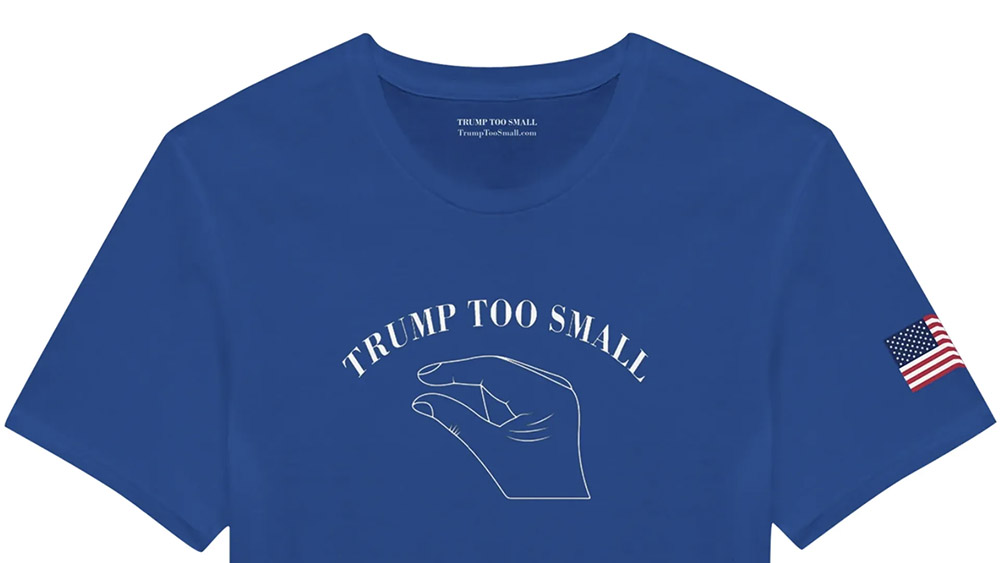
The Supreme Court recently decided, in Vidal v Elster, that the TTAB’s refusal to register the TRUMP TOO SMALL mark, was not a violation of First Amendment rights.
Background of the TRUMP TOO SMALL Trademark Application
USPTO Refusal Under the Lanham Act Names Clause
Back in 2018, Steve Elster sought to register a mark of “TRUMP TOO SMALL” as a t-shirt slogan. This was inspired by an exchange between Trump and Marco Rubio during the 2016 Republican primary. The PTO examiner refused on the grounds that the mark violated the ‘names clause’ of the Lanham Act. That act requires written consent for a mark containing the name of a living individual.
Elster countered that the ‘names clause’ was a violation of his first amendment free-speech rights. The examiner, however, responded that refusing registration doesn’t constitute a restriction on free speech. For reference, the PTO has also refused trademark registrations on “WELCOME PRESIDENT BIDEN”, “I STUMP FOR TRUMP”, and “OBAMA PAJAMA”.
TTAB Affirms Refusal of Registration
So Elster appealed the decision before the Trademark Trials and Appeals Board. But the TTAB affirmed the original decision barring Elster from registering the mark.
Federal Circuit Reversal in Re: Elster (2022)
Elster appealed the TTAB decision before the Federal Circuit. The Court noted that section 2 of the Lanham Act requires the PTO to refuse registration of certain categories of proposed trademarks. But in the last five years, the Supreme Court held two provisions in section 2 unconstitutional.
While the Federal Circuit acknowledged the TTAB’s point that the registration bar doesn’t “prevent Elster from communicating his message, it can legally disadvantage the speech at issue here.”
Political Speech and First Amendment Protections
The Fed Circuit stated that it is one of the prerogatives of American citizenship to criticize public men. In fact, the first amendment has its fullest and most urgent application to speech concerning public officials.
Therefore, suppressing the right to praise or criticize governmental agents can’t be squared with the first amendment.
Public Figures and Trademark Publicity Interests
The TTAB acknowledged this right. But added that the government’s interest in protecting privacy and publicity rights was seen to outweigh it. The Federal court argued here that Trump, as a public political figure can’t expect privacy. It further noted that one of the fundamental reasons for trademarks in the first place is the need to safeguard against the dilution of commercial value of his name, and that was not applicable here either. In summary, the government had no valid publicity interest that could overcome the first amendment protections afforded to the political criticism in Elster’s mark. As such, the Federal Circuit reversed the TTAB’s decision.
Supreme Court Review in Vidal v. Elster (2023–2024)
In 2023, the Supreme court agreed to review the judgment. The point being to resolve whether the Lanham Act’s names clause violates the First Amendment.
Content-Based vs. Viewpoint-Based Trademark Restrictions
The Supreme Court considered the issue as distinguishing between content-based, and content-neutral regulations of speech.
Content-based regulations target speech based on its communicative content and is presumptively unconstitutional. Viewpoint discrimination targets not merely subject matter, but particular views taken by speakers on the subject. Trademark restrictions that discriminate based on viewpoint violate the first amendment.
Because the names clause doesn’t single out a trademark based on the specific motivating ideology or the opinion of the speaker, it doesn’t facially discriminate against any viewpoint. But it may still be found to discriminate on viewpoint in its practical operation. Elster suggested this was the case here. It would be easier to obtain a mark if it flattered rather than mocked a subject. But there are many reasons why a person might want to withhold consent to register a trademark bearing his name.
Historical Limits on Trademarking Personal Names
While the names clause is not viewpoint based, it is content based because it applies to particular speech because of the topic discussed or the message expressed, so it turns on whether the proposed trademark contains a person’s name.
The Supreme Court reasoned that although a content-based regulation of speech is presumptively unconstitutional, it had not decided whether heightened scrutiny extends to a content-based, but viewpoint-neutral, trademark restriction. Trademark rights have always coexisted with the first amendment, and the inherently content-based nature of trademark law has never been a cause for constitutional concern.
Restrictions on trademarking names have historically been grounded in the notion that a person has ownership over his own name, and that he may not be excluded from using that name by another’s trademark. So the court issued a narrow decision that, in this instance, the particular restriction does not violate the first amendment.
USPTO AI subject matter eligibility guidance
The US Patent Office continues to issue guidance on subject matter eligibility under 35 U.S.C. § 101. This latest July guidance addresses AI-assisted inventions, and adds very little to what we already know. Basically, AI cannot be named as an inventor, and otherwise AI-assisted inventions are prosecuted the same as non-AI assisted inventions.
Invention Subject Matter Eligibility
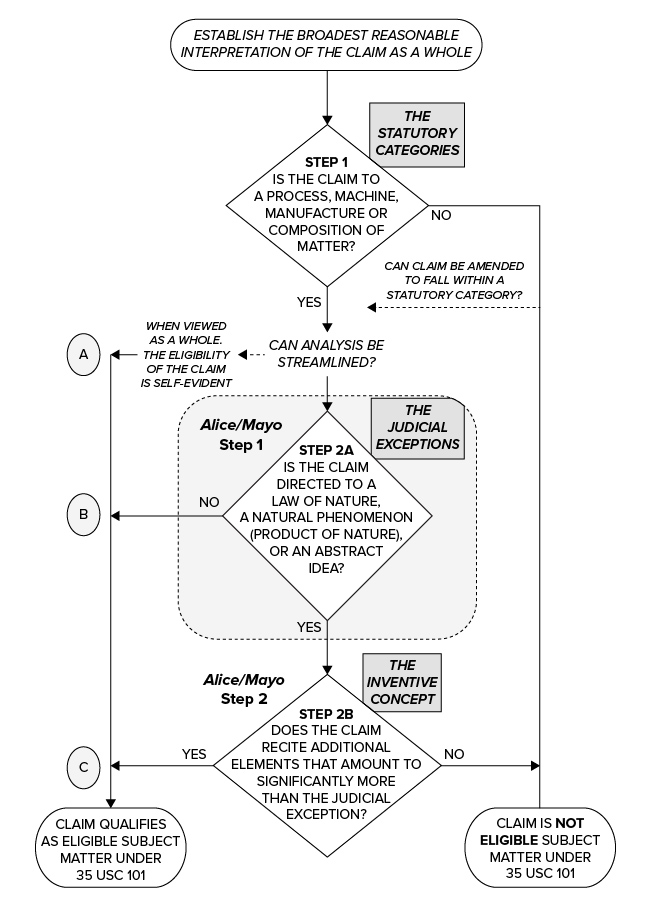
All kinds of things are eligible for patentability under the USPTO guidelines: process, machine, manufacture, or composition of matter. There are some judicial exceptions that the courts have determined are the basic tools of scientific and technological work. As such, are excluded from patentability since monopolization of these tools would tend to impede innovation more than promote it. Those judicial exceptions are laws of nature, natural phenomena, and abstract ideas.
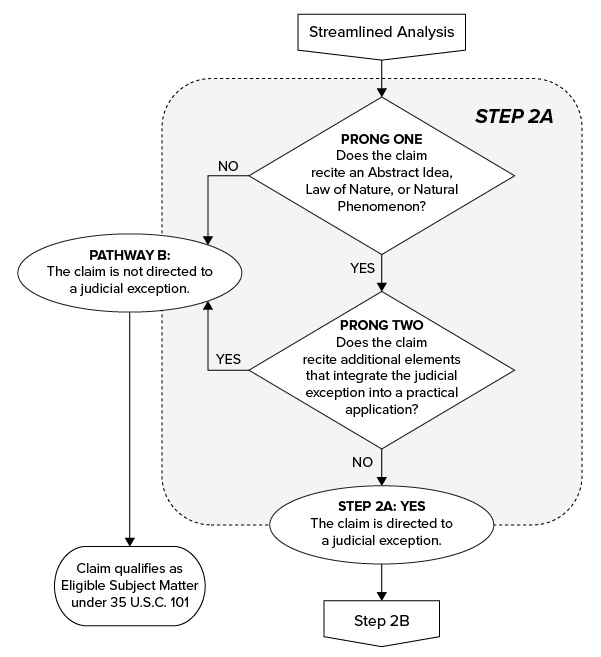
But the courts have decided that if a patent claim can recite “additional elements” that integrate the judicial exception into a practical application, then such a claim can be eligible for patentability.
First Prong: Claims Directed Towards Judicial Exceptions
In the first prong, there is an evaluation of whether a claim recites an abstract idea.
It is common for claims to AI inventions to involve abstract ideas. However, PTO personnel must draw a distinction between a claim that recites an abstract idea, and one that is merely based on an abstract idea.
The USPTO has defined three groupings of abstract ideas: mathematical concepts, methods of organizing human activity, and mental processes.
Mathematical concepts
The mathematical concepts abstract idea grouping is defined as mathematical relationships, mathematical formulas or equations, and mathematical calculations. Claim limitations do not fall within this grouping merely because they are based on or involve a mathematical concept.
Methods of Organizing Human Activity
This abstract idea grouping covers fundamental economic principles, including hedging, insurance, and risk mitigation.
It also includes commercial or legal interactions, such as contracts, legal obligations, advertising, marketing, sales activities, and business relationships.
Additionally, it encompasses managing personal behavior, relationships, or interactions between people, including social activities, teaching, and following rules.
Mental Processes
Courts consider a mental process abstract if it can be performed in the human mind or with pen and paper.
Second Prong: Additional Elements
If the claim under evaluation is directed towards one of these judicial exception areas, then the second prong of the evaluation is to identify whether there are any additional elements that would integrate the exception into a practical application. Many claims to AI inventions are eligible as improvements to the functioning of a computer or improvements to another technology or technical field. While the courts haven’t provided an explicit text for how to evaluate the improvements consideration, they have instead illustrated how it is evaluated in numerous decisions.
A key point of distinction for AI inventions is between a claim that reflects an improvement to a computer or other technology (eligible) and a claim in which the additional elements amount to no more than a recitation of the words “apply it” or are no more than instructions to implement a judicial exception to a particular technological field (ineligible).
Eligibility and AI-assisted Inventions
AI assistance is not a consideration in subject matter eligibility analysis. Patent protection can be sought for AI assisted inventions where one or more persons made a significant contribution to the claimed invention. The current guidance does not provide for recognition of tools like AI for inventorship purposes.
The Power of Arbitration Agreements in Patent Royalty Disputes
The recent case, Zimmer Biomet Holding v Insall, resulted in a judgment requiring the licensee to continue paying royalties after patent expiration. The holding conflicts with Supreme Court precedent, but was upheld based on the arbitrator’s unreviewable interpretation of the agreements.
Supreme Court Precedent on Post-Expiration Patent Royalties
There are two key precedents at issue in the Zimmer dispute: Brulotte v Thys, and Kimble v Marvel.
In Brulotte, the Supreme Court held that it is unlawful per se to have a royalty agreement extending beyond the expiration date of the patent. This was called the Brulotte rule. The rule was widely criticized at the time (1964), and the rule continued to receive criticism through the years. In Kimble, the Court provided a carve out: “post-expiration royalties are allowable so long as tied to a non-patent right”.
The Zimmer–Insall Patent License Agreement
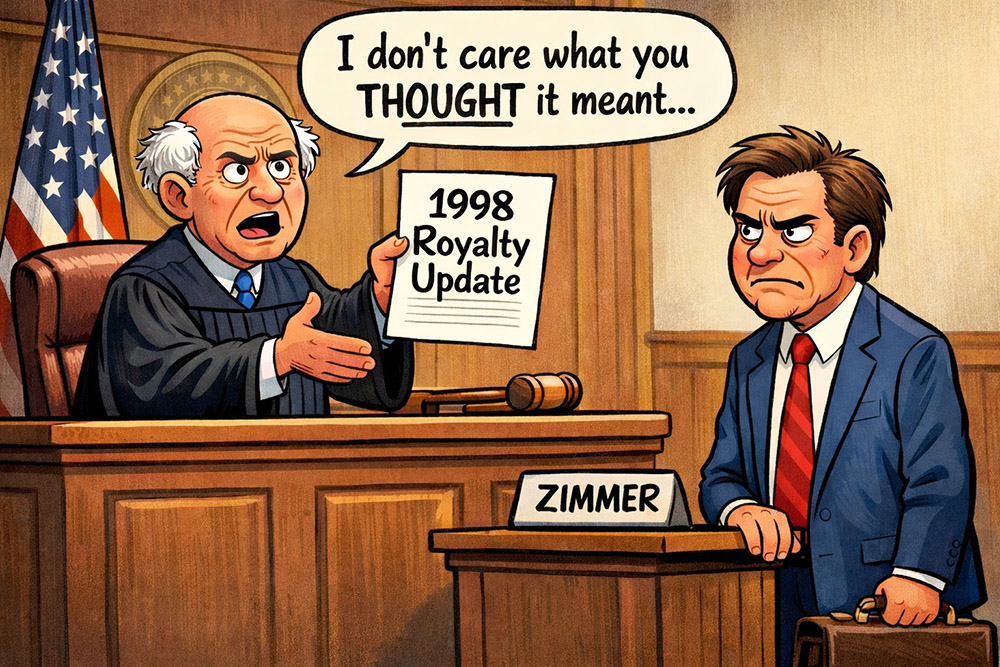
The dispute between Zimmer and Insall centered around a license to a knee replacement technology. The original 1991 agreement defined specifically that Zimmer would pay royalties to Insall on the sale of products covered by Insall’s patents. But in 1998, the agreement was updated. The update stipulated that 1% of royalties would be calculated on sales of Zimmer’s NexGen Knee family of products. Those weren’t necessarily covered by the patents.
Royalty Payments After Patent Expiration
After the Insall patents expired in 2018, Zimmer stopped royalty payments but continued to sell the products. When challenged, Zimmer argued that Brulotte rendered any post-expiration royalties unenforceable.
The parties went to arbitration in 2019, and the arbitration panel sided with Insall. The amendments to the royalty agreement effectively divorced royalties from Insall’s patents and instead married them to NexGen marketing.
District Court Upholds Arbitration Award
The issue was brought to the district court when Zimmer tried to get the arbitration award vacated on the basis that it violated the public policy established in Brulotte. The Insall estate motioned to dismiss and asked the court to uphold the arbitration’s decision. The district court agreed with the Insall estate and confirmed the arbitration award.
Federal Arbitration Act Limits Judicial Review
Zimmer then appealed this to the Seventh Circuit court. The Circuit court stressed that “arbitration awards are largely immune from…scrutiny in court” under the Federal Arbitration Act.
Under that act, arbitration awards can generally only be appealed on very narrow grounds. Those grounds were where the award violates some well-defined and dominant, explicit public policy. Then an arbitral award can be vacated. And even then, a court is bound by the arbitrator’s interpretation of the underlying contract in such an evaluation.
Key Legal Question: Patent Rights or Non-Patent Rights?
The essential question was what the royalties were based on. If they were based on Insall’s patent rights, as the original 1991 royalty agreement stipulated, then the agreement was unenforceable under Brulotte. If they were based on non-patent rights, as the 1998 amendment stipulated, they would be permissible under Kimble.
The Circuit court decided the 1998 amendments were within the arbitrator’s unreviewable authority.
Zimmer tried arguing that the amendment changed how the royalties were calculated, not why they were paid in the first place. But the court noted an “arbitration clause delegates interpretive power to the arbitrators. We don’t ask whether they read the language correctly, it is enough that they tried to apply the contract that the parties signed.”
Amazon APEX and Personal Jurisdiction
Federal Circuit Decision on Amazon APEX (May 2024)
In May 2024, the Federal Circuit issued a decision concerning a patentee’s use of Amazon’s patent enforcement process, called APEX.
Briefly, Amazon has a low-cost procedure, the Amazon Patent Evaluation Express Procedure, or APEX. The service is meant to resolve patent infringement issues for products sold on Amazon’s website. The process is meant to take only 7 weeks to get a final disposition, and costs $4000. There are several other private sales-channel enforcement processes that are becoming more popular, given the low cost and relative quickness of getting a resolution.

Case Background: LDG vs SnapPower
LDG, a Delaware LLC with headquarters in Arizona, is the owner of a patented electrical receptacle with additional functions. SnapPower, a Utah company designs, markets and sells electrical outlets as well, and uses Amazon.com as a sales channel.
In May 2022, LDG submitted an APEX challenge alleging SnapPower sold products on Amazon infringing one of LDG’s patents. Amazon notified SnapPower and both LDG and SnapPower exchanged emails and held a conference call but came to no agreements.
Declaratory Judgment and Personal Jurisdiction Dispute
SnapPower subsequently filed an action for declaratory judgment of non-infringement in its home state of Utah. LDG asked to have this dismissed for lack of personal jurisdiction, which the district court granted. The court said LDG’s allegations were directed towards Amazon in Washington, where the APEX agreement was sent.
But the Federal Circuit reversed the district court’s decision on jurisdiction.
Federal Circuit’s Three-Factor Test for Specific Jurisdiction
The court laid out a three-factor test for whether specific personal jurisdiction comports with due process:
- whether the defendant purposefully directed its activities at residents in the forum,
- whether the claim arises out of, or relates to, the defendants’ activities in the forum, and
- whether assertion of personal jurisdiction is reasonable and fair.
Application of Minimum Contacts to APEX Enforcement
SnapPower argues that LDG purposefully directed enforcement activities at Utah when it initiated the APEX program. The court agrees that LDG did so, intending effects which would be felt in Utah, so the first element is satisfied.
LDG argues SnapPower’s action for declaratory judgment of non-infringement does not arise from, or relate to, any activity by LDG in Utah because the APEX agreement was sent to Washington, not Utah.
The court held however, that LDG’s actions in submitting the APEX agreement was directed towards SnapPower in Utah and aimed to affect marketing, sales, and other activities in Utah, SnapPower’s suit arises out of the defendants’ activities within the forum. The second element is now satisfied.
Reasonableness of Personal Jurisdiction in APEX Cases
With the first two elements being satisfied, specific jurisdiction is presumed reasonable.
LDG, however, argues it is unfair and unreasonable. Ruling for SnapPower in this instance would open the floodgates of personal jurisdiction and allow suits against any APEX participant anywhere in the country. The district court agreed with LDG. It noted that principles of fair play afford a patentee latitude of its patent rights without subjecting itself to jurisdiction in a foreign forum.
The Federal Circuit, however, disagreed and ruled that LDG did not meet its burden to present a compelling case of other considerations that would render jurisdiction unreasonable. First, the Federal Circuit contested that the floodgates would be opened on personal jurisdiction. Second, disagreed that such a thing would be inherently unreasonable. The Federal Circuit said LDG initiated a process in APEX that, if SnapPower had taken no action, would have affected sales in Utah. LDG has not articulated a compelling argument for why it would be unfair or unreasonable for it to be subject to specific personal jurisdiction in Utah under these circumstances.
Cellect v. Vidal and the future of Patent Term Adjustment
Overview of Cellect v. Vidal
The U.S. Supreme Court is currently considering Cellect v. Vidal, a case with potential impact on many patents.
Cellect is the owner of 4 patents being challenged, each of which is directed towards devices comprising image sensors. The patents are all part of one patent family claiming priority from a single patent application. Because of delays during prosecution, each of the challenged patents was granted patent term adjustments (PTA) of varying lengths.
Cellect sued Samsung for infringement of these patents. Samsung responded by seeking ex-parte reexaminations, asserting that, due to Obviousness-Type Double Patenting (ODP), the patents were invalid. During the reexamination, the examiner determined that the claims were obvious variants of the prior expiring reference patent claims, and the claims were invalidated.
Cellect appealed the rejection, arguing that ODP doesn’t invalidate a validly obtained patent term extension, and therefore shouldn’t negate a statutory grant of patent term adjustment.
Understanding Patent Term Adjustments (PTA)
Some background in case the reader isn’t a patent attorney.
Prior to 1995, a patent term was 17 years from the date of issuance. Accordingly, delays at the Patent and Trademark Office (USPTO) didn’t impact patent terms because those terms began at issuance.
In 1995 the United States passed the Uruguay Round Agreements Act, which set patent terms to 20 years from earliest claimed priority date. Since all patents in a family have the same earliest priority date, it follows they would have the same expiration date. This meant that after the URAA, delays at the USPTO meant cutting into the effective term of a patent.
In 1999, the Patent Term Guarantee act, part of the American Inventors Protection Act, promised inventors a patent term adjustment period for examination delays caused by the PTO. Given the amount of delays, the PTO adjusted approximately half of the patents issued between 2005 and 2022.
One of the effects of this has been that patents in the same family routinely expire later than others due to different delays in application prosecution, and their mandated adjustments.
The Problem with Obviousness-Type Double Patenting (ODP)
So what’s the problem?
There is a ‘double patenting’ doctrine that bars applicants from receiving more than one patent on the same invention.
Way back, inventors could theoretically extend their exclusivity over an invention by claiming obvious variations of the same thing.
Staggering these applications could give the inventor a longer monopoly than was justified under the principles of the patent system. To rectify that problem the Courts developed a doctrine called obviousness-type double patenting (OPD). That doctrine was designed to prevent unjustified extensions where a later patent is merely an obvious version of a prior patent in the family. It is the extension of patent terms that is the sole basis for the doctrine.
Patent Term Extensions vs. Patent Term Adjustments
In 1984, Congress authorized patent term extensions (PTE) to compensate pharmaceutical patent holders when the FDA approval process would bar the invention from the commercial market. PTE would extend the patent term for the amount of time lost during that approval period. This is a different mechanism than PTA, which adjusts patent terms due to USPTO delays.
Federal Circuit Precedents on ODP and Term Adjustments
So, back to the situation as it stands. Where does this leave ODP? The point of ODP was to stop gaming of the system to extend patent terms. But both PTA and PTE are congressionally authorized compensations for time lost due to outside factors, not attempts to game the system. The Federal Circuit affirmed in 2007 and 2018 that differences in expiration dates caused by PTE did not trigger ODP. But the relation of ODP to PTA has been less certain.
Cellect challenged the decision before the Federal Circuit, arguing that the Board had wrongly expanded the scope of ODP, and punished patent owners whose terms had been adjusted. But the Federal Circuit upheld the decision.
Stakes of the Supreme Court Decision
The case is now before the Supreme Court and the stakes are high. The decision as it stands would largely undo Congress’s Patent Term Guarantee Act. Given the amount of patent terms that have been adjusted, there are a lot of patents that could be invalidated solely on the bases of those adjustments.