NEWS

Should Patents be Granted to AI “Inventions”?

The DABUS Case and the Question of AI Inventorship

On June 6, 2022 the Federal Circuit heard the oral arguments in the future landmark case Thaler v Vidal. These discuss the recent question on whether an AI could be the “inventor” listed on a patent application. In 2019, Thaler filed two patent applications, listing an AI called DABUS as the inventor of the two patents. The USPTO’s refused to grant Thaler the patents. Furthermore, the United States District Court for the Eastern District of Virginia upheld the USPTO’s decision.

How the Patent Act Defines an “Inventor”

      The Patent Act defines “inventor” as the individual(s) who “invented or discovered the subject matter of the invention.” Therefore, the oral argument on June 6 focused mainly on the meaning of the term “individual.” The Federal Circuit seemed skeptical of the idea that a machine can “invent” patentable subject matter with no human input. Similarly, in arguing for the USPTO, Barghaan insisted that inventions created entirely without human involvement are not patentable. Barghaan pointed out that in the Patent Act, Congress specifically defines the term “individual”. It does so using gender personal pronouns, which clearly indicates individuals as human beings, rather than machines. Moreover, Barghaan contended that allowing AI “inventions” to be patented would “open Pandora’s box” and create numerous problems. For example, he asked, how would you depose an inventor such as DABUS?

Arguments Supporting Patent Protection for AI-Generated Inventions

      Countering that, Thaler’s counsel, Abbott, noted that the Patent Act has routinely been interpreted to give terms broad meaning in order to promote innovation.

Interestingly, he contended that refusing to grant patents for subject matter invented by an AI would have a negative implication. Namely, telling companies not to use machines in research and development.

 According to Abbott’s observation, if an invention created entirely by an AI cannot be patented, companies would be disincentivized from investing in and using AI for fear of being denied protection of new inventions. This could prevent beneficial breakthroughs, such as those in the medical field. Thus, Abbott stated, interpreting “individuals” to include only natural persons will prevent innovation. That’s the opposite of what Congress intended to promote through the Patent Act.

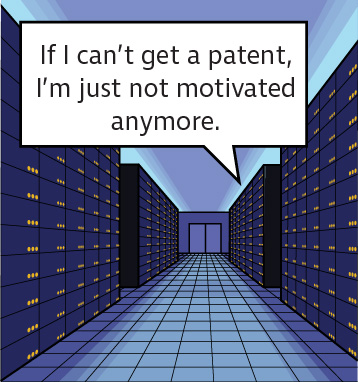
AI data center saying: "If I can't get a patent, I'm just not motivated anymore."

Prior Supreme Court Guidance on the Meaning of “Individual”

      It will be interesting to see what the Federal Circuit decides. However, it seems unlikely that the court will find in favor of Thaler. In particular, the court remarked that in Mohamad v. Palestinian Auth, the Supreme Court held that an inventor is a natural person. Abbott argued that such interpretation specifically applied only to the particular circumstances of that case. Furthermore, the Patent Act has been routinely interpreted broadly to promote innovation. However, Abbott also conceded that since Mohamad (and the Patent Act), there has been no new decision re-interpreting “individual.”

Why the Federal Circuit’s Decision Could Shape the Future of Patent Law

      No matter the outcome, the Federal Circuit’s decision will have great significance. It will considerably shape the way we think of patentable inventions. For an interesting insight on how AI might influence patent law, see How AI Might Reboot Patent Law. The article was published on Artificial Intelligence (AI) & the Law For Social Impact and Equity. It is part of a series of four blog posts analyzing Thaler’s allegations. In the first post of the series, the authors describe how Thaler has brought this fight in numerous other countries. And so far, he hasn’t had much luck in overcoming objections.

Picture of Lucia Minnucci, LL.M
Lucia Minnucci, LL.M

Lucia Minnucci is a Law Clerk at Fish IP™. Lucia received her first degree in law from the University of Bologna, in Bologna, Italy. After obtaining her law degree, Lucia received an LL.M degree from the University of Pennsylvania Carey Law School, with a concentration in Intellectual Property and Technology Law.
Update on the Chinese Foreign Filing License Requirement: Was Your Invention Developed in China?

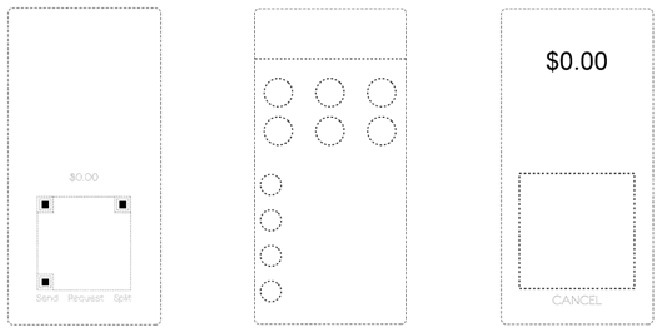
text: Foreign Filing License Requirement, over a partial map of China.

Understanding China’s Foreign Filing License Requirement

When an invention is developed in China, Chinese Patent Law requires applicants to obtain a foreign filing license before filing outside China.

Even if an applicant intends to first file outside China, a foreign filing license may still be required. Specifically, if the invention or utility model was developed in China, the applicant must first request a confidential examination from the China National Intellectual Property Administration (CNIPA). Afterward, the applicant must obtain a foreign filing license.

Challenges in Determining the Invention’s Development Location

Applicants have struggled, however, with the question on how to determine where an invention was developed. For instance, an invention could have been devised by more than one inventor. It’s possible that not all the inventors are located in the same country. It’s possible it could have been developed partially in China and partially in another country. It is becoming common for inventions to be formulated remotely by inventors located in different countries. In such instances, where the invention was first created is becoming increasingly difficult to answer.

CNIPA Criteria for Determining Development in China

A recent decision of the CNIPA, on May 9, 2022, shed some light on the matter. With this decision the CNIPA provided two criteria to determine whether an invention is developed in China. 

Substantial Similarity Between Claims Is Required

First, parity between claims matters. Prosecution disclaimer carries over only when claim language is substantially similar. Without that similarity, importing limitations from an earlier patent is improper.

Disclaimer Requires Clear and Unmistakable Statements

Second, disclaimer must be clear and unmistakable. Mere silence does not create disclaimer. 
Failure to dispute an examiner’s statement is not enough. Therefore, applicants do not need to respond to every reason for allowance.

IPR Statements Must Meet the Same High Standard

Third, the court addressed disclaimer during inter partes review. Statements made during IPR can support disclaimer. However, they must meet the same clear and unmistakable standard. Vague or broad statements generally will not limit claim scope.

Practical Guidance for Patent Prosecutors

This case offers practical guidance for patent professionals. First, differentiate claim language across related patents when appropriate. Doing so may reduce the risk of unintended limitations. Second, draft prosecution and IPR statements carefully. Avoid broad or ambiguous language that could narrow claim scope.

Finally, remember that silence is not automatic acquiescence. In many cases, there may be no need to contest every examiner comment.

Why the Maquet Decision Matters

Ultimately, Maquet helps preserve control over claim scope. It also limits the automatic spread of disclaimer across patent families.

As a result, patent owners have clearer boundaries when litigating related patents.

Both the address of the patentee and the nationality of the inventors would be considered. The address of the patentee is relevant because, where there is evidence that the patentee’s Chinese location has resources and capacity for research and development, and if there is no evidence of such resources outside of China, it is likely that the invention was developed in China.

Role of Inventor Nationality and Residency

Similarly, the CNIPA held that inventor nationality may also be relevant. Where inventors are Chinese citizens with no permanent residence outside China, the invention is more likely to have been developed in China.

However, contrary evidence may be provided. For example, inventors may show they spent significant time outside China conducting research and development.

Open Questions and Future Considerations

Nevertheless, questions remain about how these factors should be weighted. For instance, a patentee may have R&D resources both in China and abroad. Likewise, inventors may have different nationalities or residencies. In addition, at least one inventor may have contributed while outside China.

Even so, this recent decision is a positive step forward. It provides insight into which factors the CNIPA will likely consider when determining whether an invention was developed in China.

Picture of Lucia Minnucci, LL.M
Lucia Minnucci, LL.M

Lucia Minnucci is a Law Clerk at Fish IP™. Lucia received her first degree in law from the University of Bologna, in Bologna, Italy. After obtaining her law degree, Lucia received an LL.M degree from the University of Pennsylvania Carey Law School, with a concentration in Intellectual Property and Technology Law.
St. Patrick’s Day video

We’ve put together a fun video about St. Patrick’s Day. It explains who St. Patrick was, how his birthday came to be a celebration of Irish culture, and some related patents.  

Ignorance Of The Law May Be An Excuse In Copyright Registration

Supreme Court Decision in Unicolors v H&M

On February 24th, 2022, the Supreme Court has published a decision, Unicolors v H&M. Overall, the decision makes challenging the validity of a copyright registration much harder.

Copyright Registration and Infringement Lawsuits

Under the US Copyright Act, registration of a copyright is necessary to bring infringement suits. Therefore, alleged infringers often try to prove that the copyright registration is invalid. And on those grounds, the owner cannot bring the suit.

H&M’s Challenge to the Unicolors Registration

That strategy was used by H&M when Unicolors sued for infringement of several clothing patterns, and won at trial. H&M appealed, asserting that Unicolors’ registration was invalid due to an error in the application of the law.

The Key Legal Question Before the Court

The key question in Unicolors concerned mistakes in copyright registrations. Specifically, the Court asked whether both factual and legal mistakes can be excused.

Mistakes of Fact vs. Mistakes of Law

A factual error might involve the description of the work. Similarly, a legal error might involve the correct method of publication. Under the Copyright Act, a registration remains valid if the copyright holder lacked knowledge of the mistake. Importantly, the Act does not distinguish between mistakes of fact and mistakes of law. Also, the principle that “ignorance of the law is no excuse” generally applies only in criminal cases.
Therefore, the Court held that both types of errors are excused without actual knowledge.

Also, the principle that “ignorance of the law is no excuse” generally applies only in criminal cases.
Therefore, the Court held that both types of errors are excused without actual knowledge.

mistakes have been made- car underwater

Impact of the Supreme Court’s Ruling

Overall, the decision imposes a higher burden on alleged infringers. Nevertheless, copyright associations and rightsholders welcomed the ruling. For example, the Copyright Alliance praised the decision in its commentary.
It titled the article “Supreme Court (Finally) Renders a Copyright Decision That’s Not for the Birds.”

Important Warning for Copyright Holders

However, copyright holders should still exercise caution. For instance, consciously closing one’s eyes to an error is known as willful blindness. Importantly, willful blindness will not save a registration from invalidation.
Courts may interpret willful blindness as knowledge of the error. If so, the registration could still be invalidated.

Deferred Subject Matter Eligibility Program

deferred subject matter eligibility graphic

The USPTO is implementing a pilot program called the Deferred Subject Matter Eligibility response.

The point of the program is to defer the whole question of subject matter eligibility until a later stage of patent prosecution.  

Deferring subject matter eligibility allows examiners to first see if the invention clears the 112, 102, and 103 hurdles. If it is struck down in one of those categories, then no time is wasted arguing over the more difficult question of the eligibility.

For more information, check out the USPTO page: https://www.uspto.gov/patents/initiatives/patent-application-initiatives/deferred-subject-matter-eligibility-response

Postscript: The program ended on July 30, 2022 and is no longer active. The results were not what was hoped for.

European Unified Patents Update

EU map with star circle overlaid.

Ratification of the Unified Patent Court Protocol

We posted an update in November 2021. All 13 countries have now ratified the Protocol on Provisional Application of the Unified Patent Court Agreement. The European Union is now in the process of putting the court together. It may be ready within the year.

Introduction of the Unitary Patent and Unified Patent Court

The proposals call for a Unitary Patent covering participating member states. A Unified Patent Court will have jurisdiction over the litigation aspects. There is also a provision to opt out of this.

Cost Considerations for European Patent Protection

There may be a cost savings only in the event you’re seeking a patent in four or more countries. If you were only seeking patent protection in one country, it would be cheaper to prosecute in that country alone.

But this could be a great option for those seeking protection across Europe when the details are all worked out.

Transition to Unified Patent Court Litigation

It should also be noted that Unified Patent challenges will eventually be heard only in the Unified Patent Court. However, there will be a temporary hybrid situation allowing litigation through national courts.

Learn More from the European Patent Office

More information is available through the European Patent Offices page.

Venner-Shipley, one of our UK associates has provided an in-depth analysis found here.

Valentine’s Day Video

We’ve put together a little video about Valentine’s Day. 

First, we give the historical background about who Saint Valentine was, and how he came to be celebrated. Then the transformation from a feast day to a commercial holiday for lovers. Finally, we give you some Valentines-related patents, and then wish a happy valentines to all of our inventors trying to make the world a better place. Happy Valentine’s Day!