NEWS
De Minimis Defense Doesn’t Necessarily Mean Minimal Use
Understanding the Meaning of “De Minimis” in Law
There is a Latin maxim: de minimis non curat lex: “The law does not care about the smallest thing.” De minimis, in legal terms, means the thing is too trivial or minor to merit consideration.
De Minimis in Intellectual Property Infringement
In the context of intellectual property infringement, the term de minimis has commonly been understood to mean that a defendant carrying out a small number of activities within the scope of a claim might avoid liability for infringement.
Ninth Circuit Rejects Minimal Use Defense in Copyright Case
But in a recent judgment, the US Court of Appeals for the Ninth Circuit reversed a district court’s decision in favor of a defendant’s minimal use defense. A retired lawyer took a photo of a skyline and published it on various websites. He registered the photo with the copyright office 11 years later. Then he did an online reverse image search to identify infringers, and subsequently filed over a 100 infringement suits.
One of those defendants filed to have the charges dismissed using the minimal use defense and the District Court agreed. The plaintiff appealed and the Court of Appeals reversed the decision.
Court Explains Why De Minimis Is Not a Defense to Proven Infringement
They ruled that the de minimis defense wasn’t viable because the ‘degree of copying’ was total. It was an identical copy of the picture.
The court reasoned that the de minimis defense isn’t a defense of infringement. It was meant to answer whether the infringing work is substantially similar to the copyrighted work. If a similar work is different enough in substance, then infringement did not occur. But once infringement is established, de minimis is not a defense.
When a De Minimis Analysis Actually Applies
This case clarifies that a de minimis analysis applies to whether similarities between an alleged infringing work and the copyright work are too trivial or minor to merit consideration. It does not allow defendants to escape from liability for trivial amounts of infringement.
Other articles related to copyright issues: Non-Fungible Tokens and Copyrights
Patent Eligibility of Blockchain Inventions

The Australian Patent Office recently handed down a decision clarifying the patent eligibility of blockchain inventions, at least so far as Australian law is concerned.
Blockchain is a kind of database, with information, called blocks, distributed over a peer-to-peer network of individual computers, known as nodes.
The blocks are linked together sequentially to form a continuous chain. Each block contains three elements: data, a unique signature called a hash, and a hash of the previous block.
In the Australian case, an applicant sought patent protection for a recent innovation in blockchain methodology that determines a cryptographic abstract from the data, rather than the data itself, so there would be no privacy risk associated with any leak at the nodes.
An examiner initially rejected claims to that idea as unpatentable since, on the grounds that the invention was not technical in character and required only generic computer implementation. But upon review, the Delegate of the Commissioner of Patents found that the claimed method did, in fact, provide a practical and useful technical solution in preventing breaches of privacy data.
Accordingly, at least in Australia, blockchains are not inherently unpatentable.
Also concerning Australian IP: Australian Design Patent Statute Amendment
Update on IPRs
An Inter Partes Review is a proceeding before the USPTO, which allows third parties to challenge the validity of the claims of an issued patent without going into federal court. This system replaced the prior inter partes reexamination proceeding in 2012.

The USPTO offers a great summary of interesting statistics on IPR’s and other proceedings before the PTAB (Patent Trial and Appeal Board).
A few highlights: Institution rates have gone from about 87% in FY13 to about 56% in FY20. During that same time period, pre-institution settlements have remained about 9% to 12%, and post institution settlements have gone from 90% to only 20%. Of over twelve thousand petitions filed, only about thirty-four hundred have gone to final written decisions. Of the cases that were instituted but not settled, about 21% found all challenged claims unpatentable, and about 7% found all challenged claims patentable.
Prior articles on IPRs: 2020 Update on Patent Office Appeals
New FishFAQ Video: Opposing Patents
There is a new FishFAQ video up on our Fish IP Law YouTube channel. This one covers opposing patents and answers questions about keeping track of competitors patents, how to oppose competing patent apps, how to object to a patent after it issues and licensing.
If you find this helpful, please like the video on YouTube and hit the subscribe button to get new videos as they come out.
Unitary Patent in Europe
Efforts Toward a Unified European Patent System
Since the 1970s, there have been attempts to replace individual European country patents with a unified patent covering participating countries. Currently, there is a partially unified process. One application in one language is filed. However, patent protection must still be sought separately in each individual country.
By 2012, the European Council and European Parliament agreed on EU regulations that would make a unitary patent possible. However, objections among various EU members slowed progress. Nevertheless, the process is now underway again.
The European Unitary Patent and Unified Patent Court
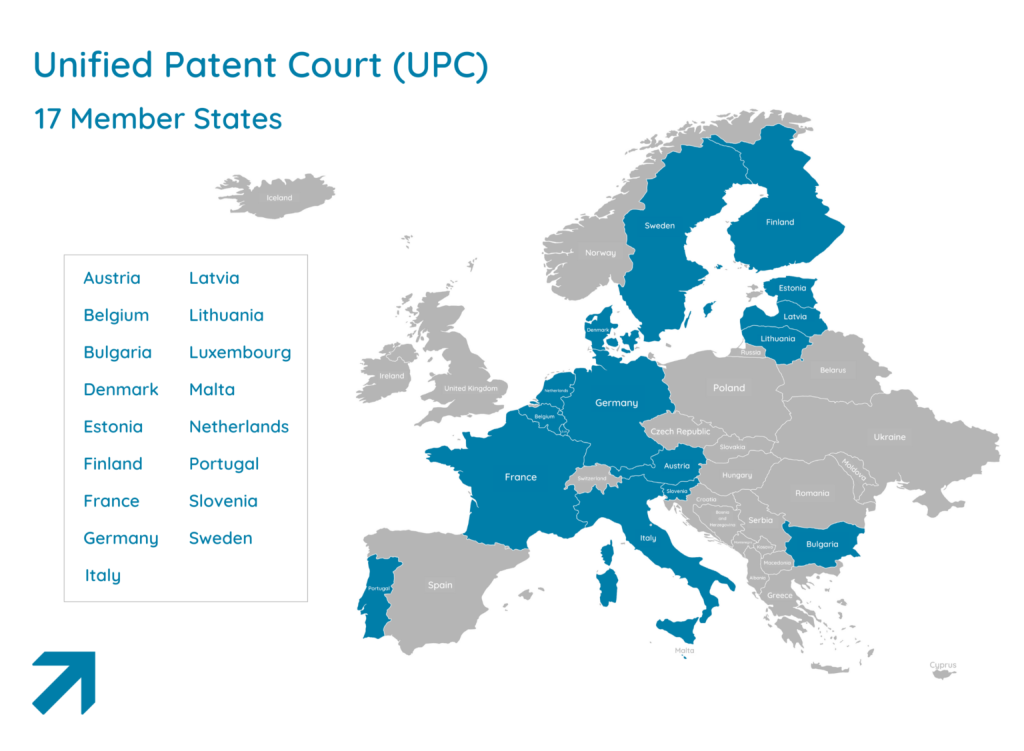
A European Unitary Patent will be a single right covering all participating EU member states. In addition, a Unified Patent Court would have jurisdiction over litigation involving those patents in participating member states.
Ratification Status of the UPC Agreement
Germany recently passed legislation opening the door to ratifying the Unitary Patent Court (UPC) Agreement. However, Germany will not ratify before the main agreement is approved. Specifically, the main agreement is the Protocol on the Provisional Application of the UPCA.
This protocol requires approval by all 13 states. Currently, twelve states have ratified. Therefore, the remaining ratification is expected in autumn of this year.
Benefits of the Unitary Patent System
A unitary patent could provide a more streamlined way to obtain broader protection. Additionally, single renewal fees will be much cheaper for inventors.
Map of Participating European Countries
Effect on Existing European Patent Rights
Patent rights obtained in individual European countries before the UPCA takes effect will remain restricted to national borders. Therefore, they will not automatically become European unitary patents.
For more information on filing for patent protection in foreign countries, see our Foreign Filing section on the Patent FAQ page.
Non-Fungible Tokens and Copyrights
NFT’s Explained
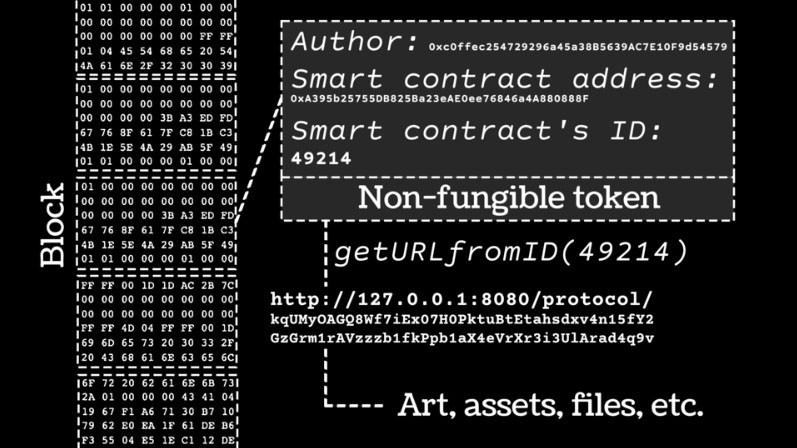
What is a non-fungible token? Non-fungible tokens (NFTs) are unique pieces of data stored on a digital ledger- a blockchain. Non-fungible just means they are unique and can’t be exactly substituted by something else. A dollar can be replaced by any other dollar, making it fungible.
Source: Wikipedia; CactiStaccingCrane
But an NFT comes with certain unique properties. Blockchains play a pivotal role by using cryptography to link blocks into a chain of data.
NFT’s in Digital Art and Media
Recently, digital assets have included art, memes, music, videos, digital 3D works, and more.
NFT Ownership vs. Copyright Rights
NFT ownership is verifiable through the blockchain and includes a license to use the digital asset. However, ownership does not automatically include copyright. Purchasing a digital art NFT grants ownership of that specific work, but not the exclusive rights to reproduce or distribute it.
Copyrights may be separately negotiated and transferred, but they are not assumed to be part of the NFT sale.
Copyfraud Risks in NFTs
Unfortunately, copyfraud*—false copyright claims on public domain content—is common in NFTs. Some actors mint NFTs without owning the copyright. Blockchain anonymity makes verifying authenticity and tracking the original owner of a digital work difficult.
We have several answers to Frequently asked questions on our Copyright FAQ section: Infringement and Litigation, that are dedicated to Copyfraud. They begin about halfway down the page.
Trademark Registration Protection in the US and Canada
The Supreme Court of Canada (SCC) has determined that registration of a trademark is a complete defense against claims for infringement and passing off. Travelway, a Canadian luggage distributor, owns a registered trademark featuring a cross that looked similar to the Swiss flag.

Travelway cross logos

Wenger logo
Wenger is the Swiss company behind the Swiss Army Knife. It had brought Travelway to court seeking expungement of the trademark. This was originally dismissed but subsequently allowed, remanding the issues to the Federal Court. In 2019, the Federal Court granted expungement, but dismissed Wenger’s claim for damages.
Wenger appealed this, with the sole issue being their entitlement to compensation. The Court of Appeal held Travelway was not liable for damages because it owned a trademark. Absent fraud, willful misrepresentation, or bad faith, a registered trademark is presumed to be valid.
This is different than the US, where a mark becomes incontestable only after 5 years has passed.
For more information on Trademarks, see our Trademark FAQs page.