NEWS

Unitary Patent in Europe

Efforts Toward a Unified European Patent System

Since the 1970s, there have been attempts to replace individual European country patents with a unified patent covering participating countries. Currently, there is a partially unified process. One application in one language is filed. However, patent protection must still be sought separately in each individual country.

By 2012, the European Council and European Parliament agreed on EU regulations that would make a unitary patent possible. However, objections among various EU members slowed progress. Nevertheless, the process is now underway again.

The European Unitary Patent and Unified Patent Court

A European Unitary Patent will be a single right covering all participating EU member states. In addition, a Unified Patent Court would have jurisdiction over litigation involving those patents in participating member states.

Ratification Status of the UPC Agreement

Germany recently passed legislation opening the door to ratifying the Unitary Patent Court (UPC) Agreement. However, Germany will not ratify before the main agreement is approved. Specifically, the main agreement is the Protocol on the Provisional Application of the UPCA.

This protocol requires approval by all 13 states. Currently, twelve states have ratified. Therefore, the remaining ratification is expected in autumn of this year.

Benefits of the Unitary Patent System

A unitary patent could provide a more streamlined way to obtain broader protection. Additionally, single renewal fees will be much cheaper for inventors.

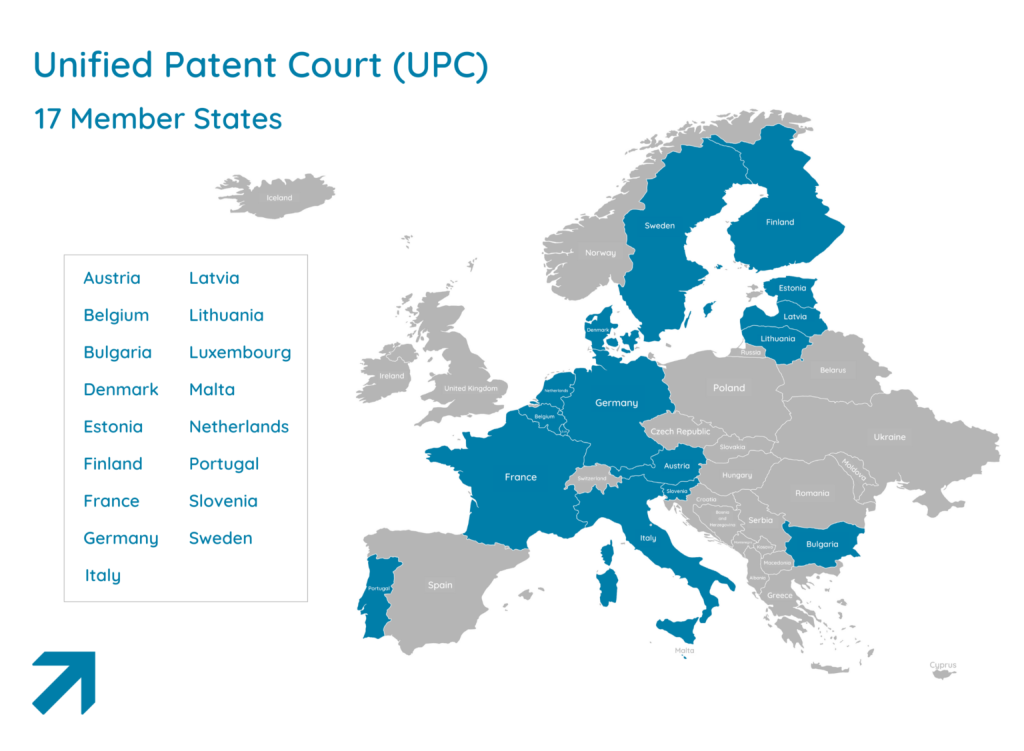
Map of Participating European Countries

map or european countries participating in the Unitary Patent.

Effect on Existing European Patent Rights

Patent rights obtained in individual European countries before the UPCA takes effect will remain restricted to national borders. Therefore, they will not automatically become European unitary patents.

For more information on filing for patent protection in foreign countries, see our Foreign Filing section on the Patent FAQ page.

Non-Fungible Tokens and Copyrights

NFT’s Explained

What is a non-fungible token? Non-fungible tokens (NFTs) are unique pieces of data stored on a digital ledger- a blockchain. Non-fungible just means they are unique and can’t be exactly substituted by something else. A dollar can be replaced by any other dollar, making it fungible. 

blockchain diagram

Source: Wikipedia; CactiStaccingCrane

But an NFT comes with certain unique properties. Blockchains play a pivotal role by using cryptography to link blocks into a chain of data.

NFT’s in Digital Art and Media

Recently, digital assets have included art, memes, music, videos, digital 3D works, and more.

NFT Ownership vs. Copyright Rights

NFT ownership is verifiable through the blockchain and includes a license to use the digital asset. However, ownership does not automatically include copyright. Purchasing a digital art NFT grants ownership of that specific work, but not the exclusive rights to reproduce or distribute it.

Copyrights may be separately negotiated and transferred, but they are not assumed to be part of the NFT sale.

Copyfraud Risks in NFTs

Unfortunately, copyfraud*—false copyright claims on public domain content—is common in NFTs. Some actors mint NFTs without owning the copyright. Blockchain anonymity makes verifying authenticity and tracking the original owner of a digital work difficult.

We have several answers to Frequently asked questions on our Copyright FAQ section: Infringement and Litigation, that are dedicated to Copyfraud. They begin about halfway down the page.

Trademark Registration Protection in the US and Canada

The Supreme Court of Canada (SCC) has determined that registration of a trademark is a complete defense against claims for infringement and passing off. Travelway, a Canadian luggage distributor, owns a registered trademark featuring a cross that looked similar to the Swiss flag.

Travelway cross logos

Wenger logo

Wenger is the Swiss company behind the Swiss Army Knife. It had brought Travelway to court seeking expungement of the trademark. This was originally dismissed but subsequently allowed, remanding the issues to the Federal Court. In 2019, the Federal Court granted expungement, but dismissed Wenger’s claim for damages.

Wenger appealed this, with the sole issue being their entitlement to compensation. The Court of Appeal held Travelway was not liable for damages because it owned a trademark. Absent fraud, willful misrepresentation, or bad faith, a registered trademark is presumed to be valid.

This is different than the US, where a mark becomes incontestable only after 5 years has passed.

New FishFAQ video: Valuing Patents

There is a new FishFAQ video up on our Fish IP Law YouTube channel. This one is on patent valuation and covers questions like what sort of due diligence is involved in valuation, the main valuation models, disparate valuations and whether you should use an outside valuation firm or not, that are found on our Patent FAQ page covering Patent Valuation.

If you find this helpful, please like the video on YouTube and hit the subscribe button to get new videos as they come out.

Good News – Chinese Trademark Office Starting to Enforce Against Squatters

graphic of red china map and text: Trademark Office squatter crackdown

Surge in Trademark Squatting After the Tokyo Olympics

In the wake of Chinese athletes’ excellent performance at the Tokyo Olympic Games, trademark squatting surged. Applicants attempted to exploit athletes’ names and related terms. The China National Intellectual Property Administration (CNIPA) cracked down on squatters and rejected 109 applications. Both the squatters and their representing agencies were publicly listed.

Chinese Courts Target Bad-Faith Trademark Applications

Chinese authorities and courts are increasingly targeting bad-faith trademark applications. Nevertheless, some bad-faith applications matured into registrations. Owners of these defective trademarks sometimes enforce them against victims of the bad-faith filings. Such owners are categorized as IPR abusers.

Now the Supreme People’s Court permits victims or defendants to claim compensation for reasonable expenses. This change makes it harder for abusers to profit from trademark squatting. Instead, squatters must compensate victims if they maliciously initiate lawsuits. 

The new interpretation makes trademark squatting and IPR abuse less profitable and riskier. This development should help purify the intellectual property environment in mainland China.

CNIPA Considers Changes to Trademark Fee Structures

CNIPA’s current fees were set very low to ensure applicants were not excluded from filing trademarks. However, these low fees dramatically increased trademark filings and piracy. To reach a more optimal fee rate, CNIPA sought public input on fee structures.

On August 25, CNIPA officially responded to proposals from the All-China Federation of Industry & Commerce (ACFIC). The agency suggested several potential changes to Chinese trademark law.

Proposed Reforms to Chinese Trademark Law

  1. Limit entities qualified to file trademark opposition and invalidation actions to prevent bad-faith oppositions. CNIPA also suggests allowing third-party opinions and adding proof requirements for non-use cancellation applicants.
  2. Raise the threshold for filing oppositions. CNIPA will consult other authorities about trademark fee structures and new compensation liability rules.
  3. Improve the delivery procedures for opposition documentation.
  4. Publicize evidence and hold hearings in opposition proceedings.
  5. Strengthen crackdowns on bad-faith applications and representation. The goal is to build a fair, honest, and credible market environment.

Australian Design Patent Statute Amendment

The Designs Amendment Bill 2020 passed both houses in Australia on August 30 and is now waiting Royal Assent.

This bill introduces a 12-month grace period for design patents, bringing it in line with other significant jurisdictions such as the US, Europe and Japan, which already provide the year grace period.

Australia’s previous lack of a grace period meant that any disclosure would show up as prior art and therefore prove fatal to patent applicability in Australia. Now an American designer, for example, would be able to disclose the design in the US, and still apply in Australia within one year.


Patented: 1000 Design Patents by Thomas Rinaldi- Book Review

Overview of Thomas Rinaldi’s Design Patent Collection

Thomas Rinaldi’s new book- Patented: 1,000 Design Patents, covers design patents, one per page and arranged chronologically, from 1900 to the present.

What Are Design Patents and How They Differ from Utility Patents

The book documents a shift in design patents over the years. Unlike utility patents, which cover how inventions function, design patents cover only the look of the object. Rinaldi traces the need for design patents back to the beginnings of mass production. This made it easier to produce objects on a large scale, and easier to copy designs.

Cover of Thomas Rinaldi's book, Patented: 1000 Design Patents.

Historical Growth of Design Patents in the United States

When design patents were introduced in 1842, there were only 14 designs registered. By the 1930’s, the patent office was issuing 3,000 design patents per year, and 6,500 by 1941. That number wasn’t surpassed until 1989 but has since swelled to around 35,000 per year.

Technology’s Role in the Modern Design Patent Boom

The huge increase in design patents today has come mostly from the tech industry. A landmark case between Apple and Samsung led to Apple being awarded $539 million. This amount was vastly larger than the usual sums awarded for design patent infringement. It also led to companies engaging in an arms race to patent as many details of their products as possible. These assets are included as part of patent portfolios that can be sold, licensed, or traded, and act as insurance policies against potential infringement litigation.

Documenting Design: Stylistic Evolution and Continuity

The book is really a documenting of design. It covers both the stylistic changes through the decades, as well as the continuity of patent drawings. That continuity demands, to this day, simple black linework on white paper. Pages will show evolution of products through the years, some relatively stable in their designs, others changing more radically. One can see on the pages the design paradigms of the shifting times- from more highly ornamental in the early decades of the 20th century, to the art deco look of the 30’s, to the ‘space age look’, etc.

You can find more information about the book here:

https://www.phaidon.com/store/design/patented-9781838662561/