NEWS
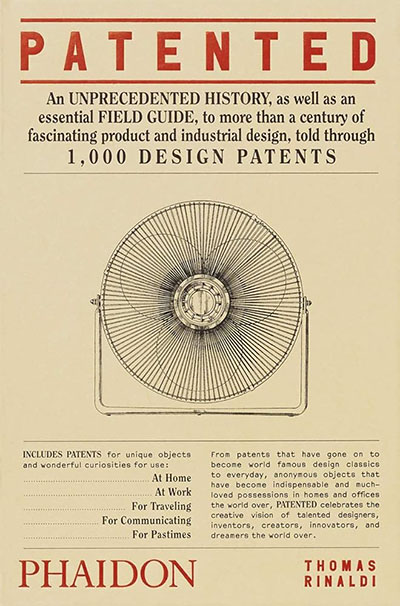
Patented: 1000 Design Patents by Thomas Rinaldi- Book Review
Overview of Thomas Rinaldi’s Design Patent Collection
Thomas Rinaldi’s new book- Patented: 1,000 Design Patents, covers design patents, one per page and arranged chronologically, from 1900 to the present.
What Are Design Patents and How They Differ from Utility Patents
The book documents a shift in design patents over the years. Unlike utility patents, which cover how inventions function, design patents cover only the look of the object. Rinaldi traces the need for design patents back to the beginnings of mass production. This made it easier to produce objects on a large scale, and easier to copy designs.
Historical Growth of Design Patents in the United States
When design patents were introduced in 1842, there were only 14 designs registered. By the 1930’s, the patent office was issuing 3,000 design patents per year, and 6,500 by 1941. That number wasn’t surpassed until 1989 but has since swelled to around 35,000 per year.
Technology’s Role in the Modern Design Patent Boom
The huge increase in design patents today has come mostly from the tech industry. A landmark case between Apple and Samsung led to Apple being awarded $539 million. This amount was vastly larger than the usual sums awarded for design patent infringement. It also led to companies engaging in an arms race to patent as many details of their products as possible. These assets are included as part of patent portfolios that can be sold, licensed, or traded, and act as insurance policies against potential infringement litigation.
Documenting Design: Stylistic Evolution and Continuity
The book is really a documenting of design. It covers both the stylistic changes through the decades, as well as the continuity of patent drawings. That continuity demands, to this day, simple black linework on white paper. Pages will show evolution of products through the years, some relatively stable in their designs, others changing more radically. One can see on the pages the design paradigms of the shifting times- from more highly ornamental in the early decades of the 20th century, to the art deco look of the 30’s, to the ‘space age look’, etc.
You can find more information about the book here:
https://www.phaidon.com/store/design/patented-9781838662561/
China implements stronger punitive damages

Recent Changes to China’s IP Legal System
China has recently made some changes to the legal system. Intentional and serious intellectual property infringement will now allow up to five times the punitive damages. This is part of an ongoing commitment to making a more favorable environment for trade, investment, and innovation.
When Punitive Damages Can Be Applied
When can punitive damages be applied? When the defendant has been determined to have intentionally infringed IP rights and the circumstances were deemed serious.
Intentional infringement includes factors such as:
Continuation of infringement after having been notified and warned;
There have been any of a number of legal connections between the plaintiff and defendant;
Piracy of false use of registered trademarks;
Other circumstances that can be regarded as intentional infringement.
Factors Determining the Seriousness of Infringement
The seriousness of the infringement will consider factors such as continual infringement even after having been punished or deemed liable by the court, forgery, destruction or concealment of evidence of infringement,
huge profits obtained from the infringement or huge losses suffered by the right-holder, endangering of national security, public interests, or personal health, etc.
Evidence Challenges and Proof Obstruction System
Evidence of IP infringement is often difficult to get. It can also be cleverly hidden in various ways, making it even more difficult for the rights-holder to obtain. Under the revised system, the method for calculating punitive damages is done with a proof obstruction system. Refusals by defendants to cooperate with providing the required records will constitute obstruction and they will bear adverse legal consequences.
Six-Step Court Process for Punitive Damages
The court go through a six-step process for determining punitive damages:
1) Determine if the IP right has been infringed
2) Review of punitive damages were requested
3) Determining if infringement was intentional
4) Determine if serious circumstances were involved
5) Determining the amount of punitive damages
6) Determine the multiple of the punitive damages
Strengthened IP Protection Through Clear Guidelines
China has now provided a clear system to the courts for determining and applying punitive damages. This reduces the burden of proof of rights holders, and ultimately strengthens the protection of IP rights.
US v Arthrex
Supreme Court Decision on PTAB Appointments
In U.S. v. Arthrex, the Supreme Court found that PTAB (Patent Trial and Appeals Board) should have been nominated by the President and confirmed by the Senate.
But instead of invalidating thousands of PTAB decisions, the Court held that PTAB determinations are reviewable by the USPTO Director.
What Changed After the US v. Arthrex Decision?
From our perspective, nothing much has changed. We continue to have the same system we’ve had for decades.
PTAB rulings have always been reviewable as a matter of right. They can be reviewed by the DC District Court, by the Federal Circuit, and theoretically, by the Supreme Court. The big change is that they are now also reviewable by the USPTO director.
Experience With PTAB Judges in Patent Litigation
Our experience (when we’ve both won and lost) is that the PTAB judges are really good at what they do. They understand the technology, and are extremely well versed in patent law. There are certainly biases from time to time. However, there’s no reason to believe that the PTAB judges would be less biased if appointed by the president and approved by the senate.
Fish IP Promo video
A little promotional video featuring our office building at Main and Jamboree in Irvine CA.
The video is 3D, and the hi-rise buildings are 3D objects. But the surrounding buildings, trees and clouds are flat, 2D objects placed in the 3D scene, so the effect is like the camera moving around props in a diorama. Hope you enjoy it.
Patents on Transactions Using Cryptocurrency: Square versus PayPal

One of the challenges of patenting technology related to blockchain is that the subject matter is likely directed to one of the judicial exceptions (i.e., abstract ideas) that are not patent eligible.
Moreover, the subject matter likely falls within one of USPTO’s enumerated groupings of abstract ideas, i.e., “certain methods of organizing human activity” (e.g., commercial interactions).
To be patent eligible, the claims would need to include additional limitations that either integrate the abstract idea into a practical application or add significantly more to the judicial exception. This article offers insight on future developments in the fintech industry and on patenting blockchain-related technology in the cryptocurrency space.
This brief references an article: Patents on Transactions Using Cryptocurrency: Square versus PayPal
Dr. Shuo Liu, Ph.D., Esq., is one of Fish IP Law’s attorneys.
Patent Prosecution Highway- Phase II

Brazil Approves Phase II of its PPH Program
The Brazilian IP Office (Instituto Nacional de Propriedade Industrial – INPI) approved phase II of its Patent Prosecution Highway (PPH) program. The program commenced on January 1, 2021.
The Patent Prosecution Highway (PPH) Program
The PPH program is a bilateral agreement between the patent offices of different countries (“member countries”). It allows for expedited examination of patent applications if a final ruling from a member country’s patent office has allowed at least one claim. That means a US patent applicant with allowed claims can file a corresponding patent application in Brazil under the PPH program to expedite examination in Brazil.
Phase II Expands Request Allowances
Phase II of Brazil’s PPH program expands the threshold number of PPH requests allowed per year. It also expands the number of PPH requests per application per week. Phase II no longer requires that the application be filed firstly with INPI. However, it also removes the ability to appeal a denied PPH request.
For More Information
For more information on expediting your US or foreign patent applications via the PPH program, contact FISH IP today.