
NEWS
False Marking
What Is False Marking?
False marking (distinct from false marketing) occurs when a product is falsely labeled as covered by an enforceable patent.
Common Ways False Marking Occurs
False marking commonly occurs in three ways:
(1) there is no patent, only a patent application;
(2) the listed patent has expired or lapsed; or
(3) the product falls outside the patent claims.
Statutory Penalties for False Patent Marking
The statutory penalty for false marking is $500 per instance. In theory, a company selling 10,000 falsely marked units could face a $5,000,000 penalty.
Congressional Changes to the False Marking Statute
When the statute was first passed, law firms saw an opportunity and began filing lawsuits aggressively. Their conduct became so widespread that Congress quickly changed the law. Congress limited the penalty to “recovery of damages adequate to compensate for the injury.”
Proving Damages in False Marking Cases
In plain English, this means the plaintiff must prove actual damages. Proving damages for false marking is extremely difficult.
Example of a False Marking Scenario
For example, suppose a competitor falsely marks chairs with the number of an expired patent. Bob avoids selling similar chairs because he fears infringing that patent. However, proving damages would still be difficult.
Bob could easily check www.PublicPAIR and discover the patent was no longer in force.
The Copyright Office’s new GRTX option
New Group Copyright Registration for Short Online Works
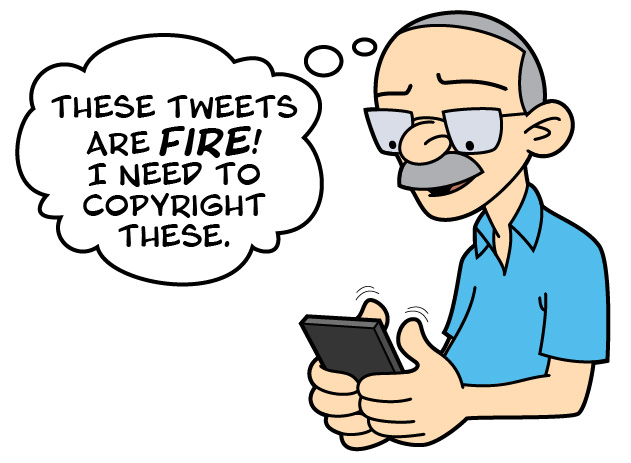
Have you ever wanted to get federal copyright protection on a whole group of your best hot-take tweets? Well, now you can! The U.S. Copyright Office has created GRTX- a group registration option.
With GRTX, authors can register up to 50 ‘short online literary works’, ranging from 50 to 17,500 words per work. As some initial requirements, the works must have all been written by the same author(s), and only text-based works are eligible. In addition, the works must have been published first online and within a given three-month period.
Works That Are Not Eligible for GRTX Registration
Emails, podcasts, audiobooks and computer programs are not eligible, even if they meet the other criteria.
Who Should Use the GRTX Group Registration Option?
So who is this for? The Copyright office created this option in response to a petition by several writers associations. It is primarily meant to help bloggers and social media posters.
Filing Fees and Benefits of Early Copyright Registration
The low filing fee of $65 covers up to 50 works). Online authors who generate continuous new content should be incentivized to secure copyright coverage early and often.
You can check out the Copyright Office’s FAQ on the subject here and Circular 67 Group Registration of Short Online Literary Works.
Can an AI machine be an inventor?
Current Patent Office Position on AI Inventors
Wow, fascinating issue, this one. For now the short answer is a simple “no”. And several patent offices across the globe have already ruled that AI machines cannot be regarded as inventors. See e.g., article by the Chinese law firm, Liu Shen.
However, as AI machines become ever more powerful, the issue is bound to come up again and again. One sign that the issue is still alive is that the U.S. Patent and Trademark Office is apparently trying to resolve several thorny issues related to AI inventors, including the following:
What constitutes an AI invention?
What constitutes an AI invention. Is it the AI database? The algorithm? How the AI is trained?
Patent Disclosure Requirements for AI Inventions
What about disclosure of the inventive subject matter? The current patent laws require that a patentable invention must be disclosed in sufficient detail that a hypothetical person of ordinary skill in the field of the invention (a PHOSITA) can make and use the invention.
Is an AI machine a sole if it comes up with a general idea, but sufficient disclosure is only provided by a human?
Would an AI Qualify as a PHOSITA?
What about that PHOSITA? With that hypothetical person include only humans? Or would it potentially include other AI machines, or other instances of the same AI machine?
Ownership and Assignment of AI-Generated Patents
What about ownership and assignment? If an AI machine has patent rights, are those rights automatically transferred to a person or company owning the AI? What if the AI is public domain? Do the patent rights go to whomever trained or used the AI? What if a person simply installed the AI on his/her computer, and that AI machine invented something without any direction at all?
Prior Art Disclosure Issues for AI Inventors
What about disclosure of prior art? Current patent law requires that an inventor disclose to the patent office all information that the inventor possesses, that a reasonable examiner would want to know about, and that is not cumulative. Depending on the AI algorithm it might be impossible for an AI machine to determine what information it used to derive the invention.
Future Legal Questions About AI and Hybrid Human-Machine Inventors
At Fish IP, we don’t see the issue going away anytime soon. What happens, for example, when electronic or bio-neural processors are embedded in brain tissue? Did an invention arise from the embedded processor, or the human part of the brain? And what if the invention arose because the electronic or bio-neural processor was communicating with others, in a sort of hive as contemplated by US patents 9,501,573 and 10,055,771?
Time to fasten your seat belt!
Patent Beast CoronaVirus Comics
We have some new Patent Beast Comics up. This short series is a riff on how clients might be assigned to the right attorney for them based on how they respond to the CoronaVirus through their choice of masks. Fans of the Harry Potter series will recognize the sorting hat and the respective colors that the clients are wearing linking them with a certain House at Hogwarts.
The full series can be found on the PatentBeast.com site.
PATENT OFFICE CATCHING UP ON PTAB APPEALS
Although the length of time that PTAB appeals are pending has only gone down slightly over the last three years, the number of new appeals has steadily declined. This seems to be the case for both inter-partes and ex-parte appeals.
It’s not clear why that has happened. One theory is that the relatively lower cost of IPRs and other appeals has made patent holders more likely to settle with a potential competitor – to avoid a relatively high chance of the patent rights being voided.
POTENTIAL PROBLEMS WITH FILING A SECOND PROVISIONAL APPLICATION
US Provisional Applications: Duration and Abandonment
Provisional applications in the US last only one year. If no utility or international application is filed during that one-year window, the provisional is abandoned. At that point it cannot be used to claim priority. Sometimes applicants are not ready to file a utility or international application during that year, so they re-file the provisional.
Risks of Re-Filing a Provisional
The problem arises if the re-filed provisional is submitted while the earlier provisional is still pending. Priority claims to the re-filed provisional may then fail in later national or regional phase applications.
Paris Convention Requirements for Priority Claims
Article 4(c)(4) of the Paris Convention states that a later-filed priority application can only claim priority over an earlier one if certain conditions are met. One condition is that no rights remain from the earlier application when the later one is filed.
European Patent Office: Re-Establishment Requests
In the European Patent Office (EPO), a request for re-establishment can be filed up to two months after the one-year window of the earlier provisional. If granted, rights from the earlier provisional remain, and priority to the later application would fail.
Best Practices for Provisional Filings
Best practice: if a re-filed provisional will serve as priority for a PCT application, the earlier pending provisional should be expressly abandoned first.
Kudos to Terri Shieh-Newton, PhD of Mintz-Levin for pointing out this problem.
2020 UPDATE ON PATENT OFFICE APPEALS
Patexia is a terrific resource for statistics regarding intellectual property. Earlier this week Patexia reported that there has been a 20% drop in IPR (Inter-Partes Review) petitions since 2019. Their 4th Annual IPR Intelligence Report, which can be purchased for $1495, breaks out IPRs handled by each law firm during the last five years, including a gauge of success rate.
Fish IP has represented both petitioners and patent owners in over 10 post-grant proceedings before the Patent Trials and Appeals Board (“PTAB”), including both Inter Partes Reviews (“IPR”) and Covered Business Method (“CBM” reviews). Fish IP has achieved over a 90% success rate before the PTAB, and 100% success rate on appeals to the Federal Circuit.
Fish IP’s work included winning one of the first ever CBM trials, and – at the time – one of only six (6) successful patent owner motions to amend (as cited by the U.S. Supreme Court). The technologies in Fish IP’s proceedings ranged from financial software to a variety of mechanical and electrical engineering inventions. Fish IP’s work also resulted in several precedential opinions from the PTAB.